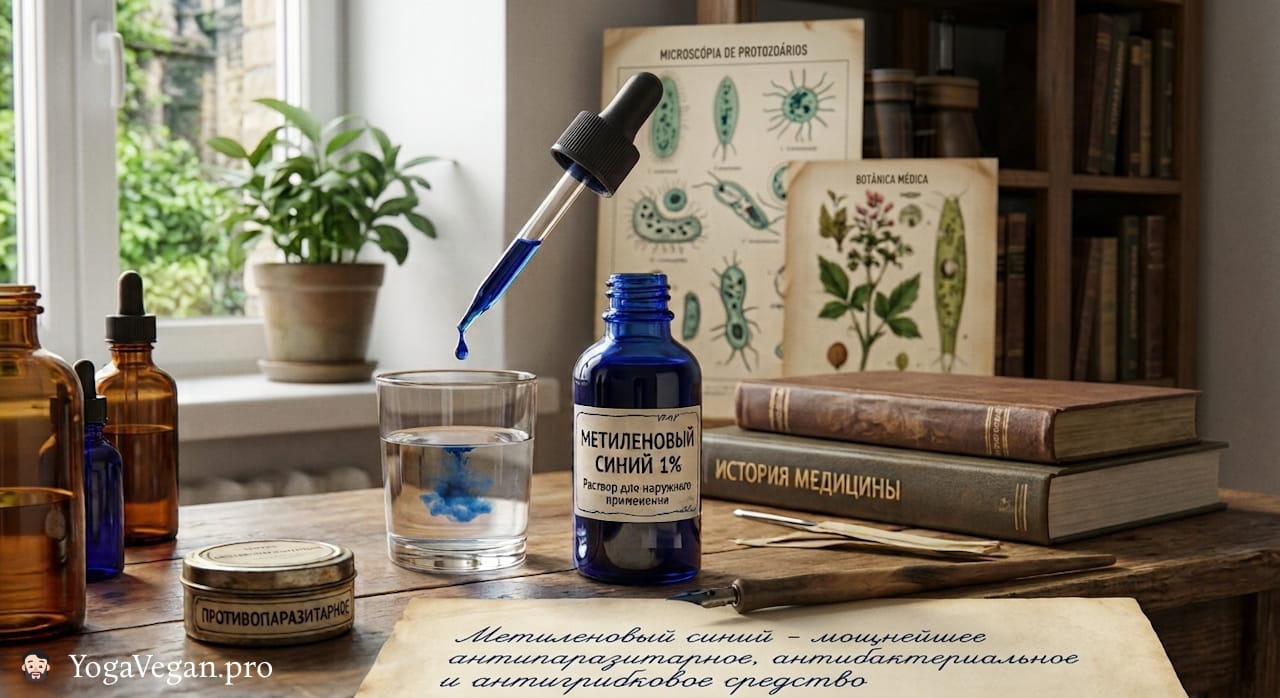
🛡️ Methylene blue - the most powerful remedy against parasites, fungi, and bacteria
Methylene blue (hereinafter — MB) is an excellent antiparasitic, antibacterial, and antifungal drug that I used for a month in the amount of 1 spray of 1% preparation for external use, approximately equal to 10 drops, in a glass of 200 ml of water every morning on an empty stomach. I used it for prevention and testing. In general, no side effects were noticed, there is a result. Clarity of mind is good. A friend recommended it to me.
In this article I speak on my own behalf and only about my own experience and do not claim to be the ultimate truth. More details on the main page below: 👋 Hi! A few words about something important
Before use, I studied information about MB. Alexander Mishin speaks very well about it, yes, the very one who released his coils under the same name. But there are plenty of other people on the internet who praise this drug. People praise it as the strongest antifungal, antibacterial, antiparasitic (I do not speak about viruses, they do not exist, more about that later) and even curing cancer (not surprising, I already spoke about cancer and its cause earlier: from parasites and from fungi). MB has its own communities: Telegram group. There are even preparations with methylene blue for internal use: suppositories from the company Vitaukt. In general, below I structure the information known to me.
Methylene blue, which is sold in pharmacies as a blue solution, is the oldest synthetic medicine. MB was first synthesized in 1876 by the German chemist Heinrich Caro (working for BASF) initially as a dye for cotton. It was introduced into medicine by Robert Koch in 1882, used as a dye for microscopy (for staining the causative agent of tuberculosis). A little later, in 1891, Paul Ehrlich and Paul Guttmann began using it to treat malaria, which became one of the first examples of "chemotherapy" of infections. In 1932 Geiger began using methylene blue to treat cyanide poisoning.
🌱 Safety of use
Now in Russian pharmacies MB is sold freely for external use, usually 1% or 2% aqueous solution (often called "sinka" or pyoctannin), and recently internal suppositories from the company Vitaukt have also appeared. Its main properties are antiseptic and astringent. The solution is applied to cleansed skin, it dries and disinfects but strongly stains everything around. It was also actively used in the USSR. In official medicine it is used for:
- Pustular skin diseases (pyoderma, impetigo).
- Wounds, ulcers, burns, bedsores.
- Weeping eczema and fungal skin lesions.
- Viral lesions (e.g., herpes simplex) — thanks to the ability to damage the nucleic acids of viruses upon contact with light.
Since it is used for such wounds and sores, it means it freely enters the blood, which excludes its danger in small doses, otherwise it would not be used. It is also used for disinfecting water directly with fish in an aquarium, which do not die from MB. Which also confirms its safety.
There is an officially registered preparation for oral (through the mouth) intake, approved in the European Union under the name Lumeblue (active substance — methylthioninium chloride). In Russia there are prescription prolonged-release tablets of 25 mg, coated with an enteric coating, which are taken orally 3 tablets at a time with an hour break and a total of up to 8 tablets are used. 8 tablets correspond to 200 mg or 400 drops or 20 ml = 20 cubes of a syringe with 1% MB solution.
The official indication for use is diagnostic: the drug is used to improve the visualization of the colon mucosa during colonoscopy so that doctors can more easily detect anomalies (e.g., polyps). The tablets have a special enteric coating that prevents the drug from being absorbed in the upper gastrointestinal tract and releases the dye only in the colon for diagnosis. Based on clinical study data, the absolute bioavailability of Lumeblue is approximately 100%. This means that all the methylene blue released from the tablets is absorbed into the blood, though slowly from 10 to 24 hours. Which confirms the safety of MB, otherwise it would not be used, and especially in such a concentration.
🔍 Moreover, in the USSR work was carried out to study the action of MB
"M. b. is used mainly as an antiseptic and as an antidote for a number of poisonings (see Antidotes of CW). As an antiseptic M. b. is prescribed in the form of 0.02% aqueous solution (for washings in cystitis, pyelitis, etc.) or in the form of 1–3% alcohol solutions for external use (for burns, pyoderma, and other skin lesions).
For diseases of the urinary tract M. b. can be prescribed internally: for adults 0.1 g 3–4 times a day, for children — in a daily dose based on 0.005–0.01 g per each year of life (in 3–4 doses).
As an antidote for poisoning with cyanides, hydrogen sulfide, and carbon monoxide M. b. is administered intravenously in the form of 1% aqueous solution of 50–100 ml. For the same purpose sometimes 50–100 ml of "chromosmon" is used — 1% solution of M. b. in 25% glucose solution. M. b. accepts hydrogen, which during cyanide poisoning accumulates in mitochondria in the form of a proton and thereby eliminates one of the causes of inhibition of biological oxidation processes. In addition, M. b. converts hemoglobin into methemoglobin, which firmly binds cyanides.
In small doses (0.1–0.15 ml of 1% solution per 1 kg of body weight intravenously) M. b. causes the reduction of methemoglobin to hemoglobin and therefore can be used for poisoning with methemoglobin-forming poisons (see Methemoglobinemia)." - Mashkovsky M. D. "Medicinal Products" 1977, Romeis B. Microscopic Technique, trans. from German, 1954.
Source: medofria
It turns out the source confirms the safety of MB in amounts not exceeding the doses described above. And the dose here is indicated at 0.1 g of MB powder = 10 ml (10 cubes) = 200 drops of 1% solution. It seems very significant.
Also, the same amount of MB was found in the method of its application on the website of medicinal products: medkurs
✅ Well, of course, now the company Viktaut with its suppositories with MB with a dosage of 10 mg in one suppository = 20 drops or 1 ml = 1 cube for the equivalent of 1% solution puts all the dots over the safety of use. They also have links to scientific literature confirming the safety of MB.
💙 Why MB was so loved in the USSR
MB or in common parlance "sinka" had several key advantages that made it indispensable in certain situations:
- Gentleness for mucous membranes: Glycerin solution of methylene blue stayed on the mucous membrane longer and did not sting, so it was prescribed to children for stomatitis and "thrush" in the mouth. Treating the oral mucosa with brilliant green would be too aggressive.
- Treatment of angina: Old-school doctors advised "sinka" for lubricating the throat and tonsils in tonsillitis (angina), especially in small children who cannot gargle. It was enough to put a "dot," and saliva carried the solution throughout the cavity.
- "Marker" of treatment: A bright blue spot was an excellent visual indicator — you can immediately see where it has already been treated and where not. This helped both parents and the children themselves (psychologically "not to touch the wound").
- Antidote in hospitals: In addition to external use, in Soviet hospitals methylene blue in ampoules with glucose was a standard antidote for poisoning with carbon monoxide, hydrocyanic acid, hydrogen sulfide, and methemoglobin formers.
🪱 Destruction of parasites
Against parasites MB works as a "subversive substrate." It interferes with the redox processes of the parasite:
- Disruption of redox balance: MB selectively affects the enzymes of the parasite (e.g., glutathione reductase) involved in protection from oxidative stress. This leads to the accumulation of reactive oxygen species and the death of the parasite.
- Selectivity: MB accumulates in infected erythrocytes, which allows attacking the parasite inside the cell.
🦠 Destruction of bacteria and fungi
The main mechanism of action on microorganisms (bacteria and fungi) is photodynamic (requires light):
- Activation by light: MB accumulates in the cells of bacteria and fungi. When irradiated with light (usually red, ~660 nm) the MB molecule goes into an excited state and transfers energy to oxygen, creating singlet oxygen and other reactive oxygen species (ROS).
- Cell destruction: ROS attack membranes, proteins, and DNA, causing the death of microorganisms. This method is called antimicrobial photodynamic therapy (aPDT).
- Effectiveness: Studies show high effectiveness against a wide range of bacteria (including MRSA and Pseudomonas aeruginosa) and fungi (Candida albicans, Microsporum canis), causing a decrease in survival by 3–5 orders of magnitude (99.9–99.999%).
🧠 How MB acts on the brain when taken internally
- Mitochondria support: The brain is the most energy-consuming organ, and MB helps mitochondria use oxygen more efficiently to produce energy.
- Antioxidant action: In low doses it works as an antioxidant, protecting neurons from damage.
- Effect on neurotransmitters: MB is a monoamine oxidase (MAO) inhibitor, which allows serotonin and dopamine to remain active longer, affecting mood and energy.
🐀 Animal studies
There are many results here, and they look impressive:
- Memory improvement: In rats low doses (e.g., 1 mg/kg or 4 mg/kg) improved the retention of spatial memory and extinction memory of a conditioned reflex.
- Neuroprotection: In traumatic brain injury in mice MB reduced inflammation and protected cognitive functions by affecting the quality of mitochondria. During exhausting physical loads intranasal administration protected hippocampal neurons.
🦞 Methylene blue as a photosensitizer for the treatment of oncological diseases
Photodynamic therapy (PDT) is a method in which light, a photosensitizer, and molecular oxygen together cause cell death. Methylene blue is a promising photosensitizer with a wide spectrum of action, so it is being studied in various fields of medicine.
In this work scientists studied the possibility of using the photodynamic effect of methylene blue in the treatment of oncological diseases. The experiment was conducted on seven-month-old mice: mitochondria were isolated from their brain. It turned out that methylene blue in combination with PDT causes significant damage to mitochondrial DNA (mtDNA), which leads to the death of tumor cells. Optimization of this model remains an urgent task of modern medicine.
The study was conducted by: FGBOU VO VSU, Department of Genetics, Cytology, and Bioengineering
⚠️ Precautions
MB is not recommended to be used together with medications. As an MAO inhibitor, it can cause dangerous serotonin syndrome when combined with antidepressants or other agents that increase serotonin.
Industrial and aquarium versions contain toxic impurities and are not suitable for medical use.
👨⚕️ Recommendations of Dr. Evdokimenko
Although the recommendations relate to the treatment of COVID, they fully serve for the prevention and treatment of other diseases caused by parasites, bacteria, and fungi. In the circle of doctors and ordinary people MB has shown high effectiveness and people have left numerous positive reviews about it.
📋 There are very few contraindications to such treatment
- The first contraindication is, of course, an allergy to Methylene blue itself.
- The second — pregnancy and breastfeeding; children under 12 years of age.
- The third — methylene blue is a monoamine oxidase inhibitor, so it cannot be taken internally simultaneously with antidepressants of the selective serotonin reuptake inhibitor group.
✍️ How to take
For treatment in this case, strictly 1% aqueous solution of Methylene blue is used. 10 drops of this 1% aqueous solution of Methylene blue are usually diluted in a whole glass of water (but the first time it is better to start with 5 drops). The water should NOT be hot, but not too cold either. Ideally — room temperature. This glass is drunk SLOWLY, 1 time a day, course 3-5 days, maximum 7 days. In case of extreme necessity, and only with good tolerance, such a solution is drunk 2 times a day.
Source of application recommendations: Dr. Evdokimenko
📚 Literary sources on MB
- Muehler et al., 2022 — The study showed that photodynamic inactivation with methylene blue and TMPyP damages the membranes of E. coli and S. aureus, which leads to the death of bacteria.
- Teichert et al., 2002 — Photodynamic therapy with methylene blue effectively treated oral candidiasis in immunodeficient mice.
- Kustov A.V. et al., 2025 — The use of photodynamic therapy with methylene blue in chronic cystitis is described.
- Hosseini et al., 2016 — The sensitivity of C. albicans and C. dubliniensis to photodynamic therapy with four dyes was studied; methylene blue was among the studied photosensitizers.
- Vasyuchenko E.P. et al. — Molecular modeling of the interaction of methylene blue with the viroporin of the SARS-CoV-2 coronavirus was conducted.
- Ahn et al., 2017 — Methylene blue suppresses the activation of several types of inflammasomes (NLRP3, NLRC4, AIM2, and non-canonical), which indicates its anti-inflammatory potential.
- Xiong et al., 2017 — Methylene blue exhibits anti-aging properties for human skin, contributing to its longevity.