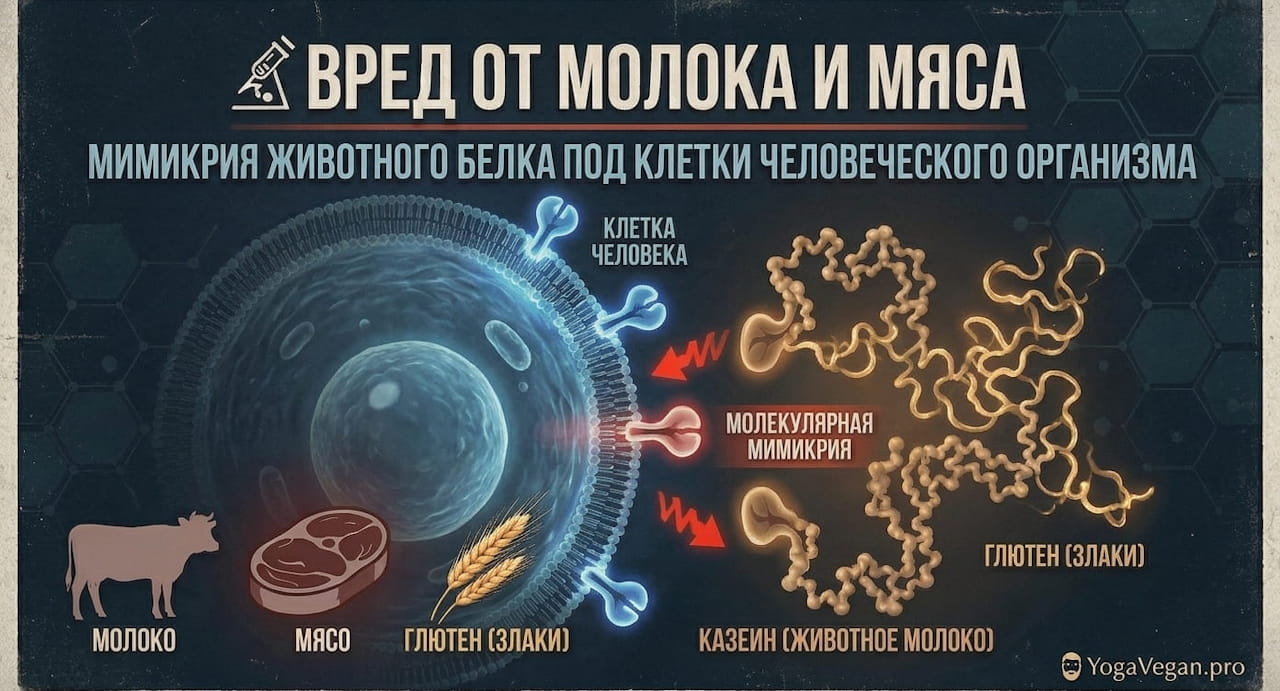
🧬 Mimicry of animal protein under the cells of the human body
Earlier there was an article about the harm of gluten and its molecular mimicry was analyzed. A similar effect on the body is exerted by the protein of milk, meat, poultry, fish, and reptiles (they go in order of danger from greater to lesser). The essence is that some proteins in their structure can be similar to the proteins of the body's own cells. The immune system, attacking "foreign" proteins, may mistakenly begin to attack its own tissues similar to them.
💡 The main idea of molecular mimicry is that the closer an animal is to a human physically, the higher the probability that some of its proteins will be structurally similar to human ones, which can confuse the immune system.
More than 80 types of autoimmune diseases are officially registered that can be caused by gluten or milk protein. These diseases can affect almost any part of the body: from joints and skin to the thyroid gland, nervous system, and intestines.
Here is a part of them, consisting of 25 names: type 1 diabetes mellitus, rheumatoid arthritis, systemic lupus erythematosus, psoriatic arthritis, ankylosing spondylitis (Bechterew's disease), scleroderma, celiac disease, Crohn's disease, ulcerative colitis, autoimmune pancreatitis, autoimmune hepatitis, autoimmune thyroiditis (Hashimoto's disease), Graves' disease, Addison's disease, multiple sclerosis, Guillain-Barré syndrome, myasthenia gravis, acute disseminated encephalomyelitis, psoriasis, vitiligo, pemphigus, alopecia areata, autoimmune hemolytic anemia, idiopathic thrombocytopenic purpura, vasculitis (including Wegener's granulomatosis and polyarteritis nodosa).
🍼 The link of milk proteins with the development of type 1 diabetes mellitus — an autoimmune disease in which the immune system destroys pancreatic cells that produce insulin — is the most studied.
🔬 Studies of molecular mimicry: In several scientific works, including using computer modeling methods (in silico), it was shown that cow's milk proteins such as bovine serum albumin (BSA) and beta-lactoglobulin (BLG) have significant similarity in amino acid sequence with human beta-cell antigens (for example, GAD-65 and insulin itself).
🧪 Antibodies to milk proteins: In people with newly diagnosed type 1 diabetes and with latent autoimmune diabetes in adults (LADA), elevated levels of antibodies to beta-casein (another milk protein different from human) are found. This suggests that their immune system is actively reacting to the protein.
"The body responds with an immune reaction, which can manifest itself in the form of skin diseases, frequent colds, autoimmune pathologies of the thyroid gland, internal organs, joints. The body cannot fully process dairy products, and part remains in the intestine, being attracted by sticky villi, which causes a violation of parietal blood circulation. The immune system begins to produce antibodies, large immune complexes are formed, and they already enter the internal environments of the body. Wherever they come, there will be an autoimmune reaction." Margarita Koroleva - dietitian, doctor of medical sciences
⚠️ There is also lactose intolerance from milk - this is not an autoimmune reaction but a lack of the enzyme for breaking down milk sugar. It causes discomfort from the gastrointestinal tract but is not connected with the "confusion" of proteins.
🧬 The mechanism of molecular mimicry, similar to milk proteins, also works for proteins from meat and other animal products, including poultry, fish, and reptiles. The essence is that proteins from food can have a structure similar to the proteins of the body's own tissues. The immune system, reacting to a "foreign" food protein, may mistakenly begin to attack "its own" cells too, launching an autoimmune process. And the closer the proteins are in their characteristics to human proteins, the more pronounced the molecular mimicry.
📚 Here is what is known from some studies
🥩 Studies on animal proteins: Classifying allergens of animal origin (for example, tropomyosins from seafood, casein from milk), scientists found that their evolutionary proximity to human proteins can erase the line between "own" and "foreign" for immunity. This means that the immune response to such proteins risks developing into an autoimmune one. Source
🐖 A specific example with pork meat: In one study it was found that pork proteins contain the largest number of peptide sequences matching epitopes associated with human autoimmune diseases. The authors suggested that this may explain why in some cultures there are prohibitions on the consumption of pork. Source
🐄 Beef: Antibodies to beef proteins (bovine serum albumin and gamma globulin) were found in a significant part of patients with systemic lupus erythematosus. The authors believe the cause is food antigens entering the bloodstream and forming immune complexes. Source
Other scientific studies from the article: