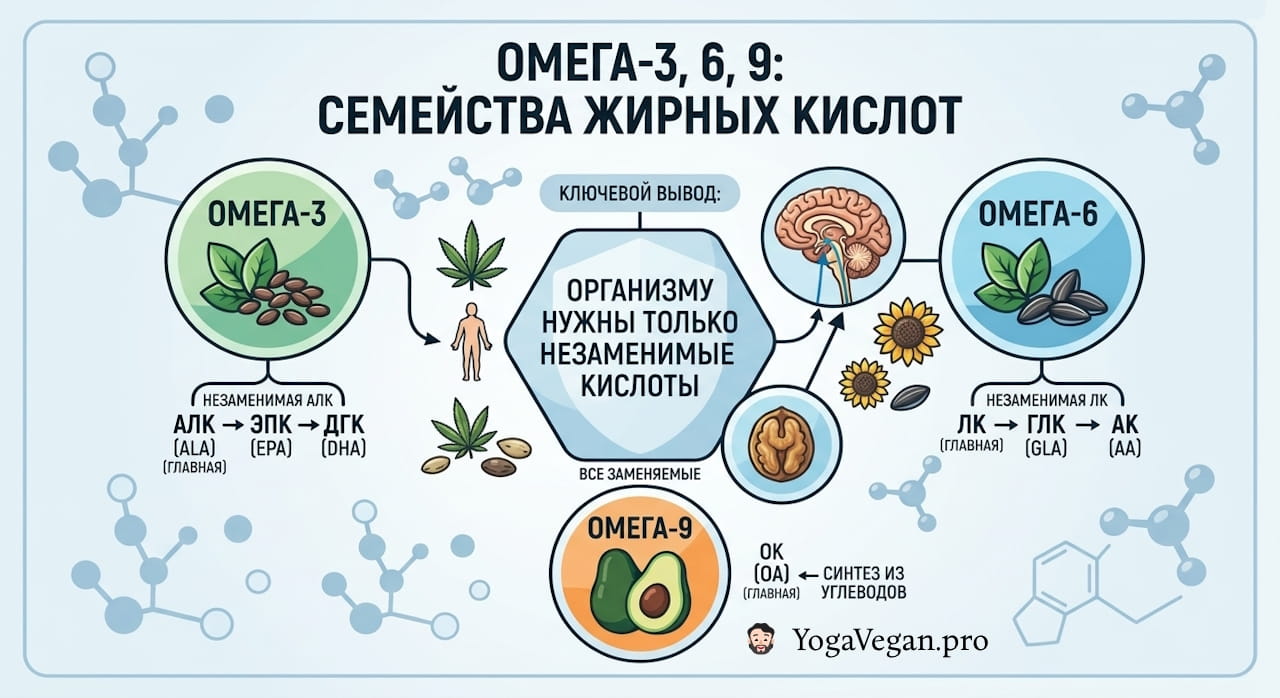
🌿 Omega-3, 🥬 Omega-6, 🥑 Omega-9 — why were they invented? Only alpha-linolenic and linoleic fatty acids are important.
When we say "omega-3", "omega-6" or "omega-9", we mean not one substance but entire families of fatty acids. The number in the name indicates where the first double bond is located, counting from the methyl end (omega-end) of the molecule. In omega-3 it is on the third carbon atom, in omega-6 — on the sixth, in omega-9 — on the ninth. This chemical difference determines how the acids behave in the body.
In each group of Omega acids, only 1 acid is needed from which the body can obtain all other fatty acids in this group. In fact, we need essential fatty acids: alpha-linolenic acid (ALA) from the omega-3 group and linoleic acid (LA) from the omega-6 group. From the omega-9 group, oleic acid is reproduced in our body from carbohydrates.
🌿 Omega-3: three key acids with the main alpha-linolenic acid
The omega-3 family includes three main acids:
- Alpha-linolenic acid (ALA) — 18 carbon atoms, 3 double bonds (18:3 n-3). This is the "parent" acid of the family. The body cannot synthesize it itself, so ALA is essential and must come from food. In the body ALA can successively convert into other omega-3 acids: Alpha-linolenic acid → EPA → DHA. Sources: flax seeds, chia seeds, hemp seeds, walnuts, pecans.
- Eicosapentaenoic acid (EPA) — 20:5 n-3. Formed from ALA.
- Docosahexaenoic acid (DHA) — 22:6 n-3. The end product of the conversion chain.
🥬 Omega-6: four main acids with the main linoleic acid
This family includes several important acids that differ in chain length and number of double bonds.
The main ones:
- Linoleic acid (LA) — 18:2 n-6. This is the "mother" or essential acid. The body cannot synthesize it itself and must obtain it from food. It serves as a precursor for all other omega-6 acids. In the body linoleic acid successively converts into other omega-6 acids: Linoleic acid → GLA → DGLA → AA. Sources: sunflower seeds, pine nuts and walnuts, Brazil nuts, pecans, pumpkin seeds, sesame seeds.
- Gamma-linolenic acid (GLA) — 18:3 n-6. Formed from linoleic acid.
- Dihomo-gamma-linolenic acid (DGLA) — 20:3 n-6. An intermediate link in the conversion chain.
- Arachidonic acid (AA) — 20:4 n-6. This is the most important biologically active acid of the omega-6 family. It is formed from DGLA and participates in the work of the immune system and inflammatory processes. It can also come from food.
🥑 Omega-9: four main acids without essential acids with the main oleic acid
Omega-9 — monounsaturated fatty acids. The body can synthesize all of them itself, so they are not essential. In this group everything starts with oleic acid. It is also synthesized from carbohydrates. The full path: Carbohydrates → Acetyl-CoA → Palmitic acid → Stearic acid → Oleic acid.
The main representatives of this group:
- Oleic acid (OA) — 18:1 n-9. The most common. Source — olive oil. In the body oleic acid successively converts into other omega-9 acids: Oleic acid → GA → EA → NA. Sources: avocado, macadamia nuts, hazelnuts, almonds.
- Gondoic acid (GA) — 20:1 n-9. Formed from OA.
- Erucic acid (EA) — 22:1 n-9. Formed from GA.
- Nervonic acid (NA) — 24:1 n-9. Formed from EA. A component of myelin in the nervous system.
📝 Summary on Omega fatty acids
In each omega family there is one founding acid from which the body builds all the others:
- Omega-3 → everything starts with alpha-linolenic acid (ALA)
- Omega-6 → everything starts with linoleic acid (LA)
- Omega-9 → everything starts with oleic acid (OA)
🥬 Alpha-linolenic acid (Omega-3). Norm: 0.8–1.6 g/day
- Flax seeds — 23.2 g per 100 g (1450–2900% of the norm)
- Chia seeds — 17.5 g per 100 g (1090–2190%)
- Hemp seeds — 8.7 g per 100 g (540–1090%)
- Walnuts — 2.0 g per 100 g (125–250%)
- Pecans — 1.0 g per 100 g (63–125%)
🌿 Linoleic acid (Omega-6). Norm: 8–10 g/day
- Sunflower seeds (roasted) — 35.7 g per 100 g (357–446% of the norm)
- Pine nuts — 32.1 g per 100 g (321–401%)
- Walnuts — 32.1 g per 100 g (321–401%)
- Brazil nuts — 21.4 g per 100 g (214–268%)
- Pecans — 21.4 g per 100 g (214–268%)
- Pumpkin seeds (raw) — 21.4 g per 100 g (214–268%)
- Sesame seeds — 21.4 g per 100 g (214–268%)
🥑 Oleic acid (Omega-9). There is no norm since the body can synthesize it itself from carbohydrates.
- Macadamia nuts — 43–44 g per 100 g
- Fresh hazelnuts — 45 g per 100 g
- Fresh almonds — 31 g per 100 g
- Avocado — 6–14 g per 100 g
💡 Key conclusion
Our body can make fat from carbohydrates, and fat, as it happens, consists of different fatty acids. This is called lipogenesis. The body cannot synthesize only alpha-linolenic acid and linoleic acid. It can also break down other fat entering it into fatty acids and from this synthesize the fat or fatty acids it needs.
By getting alpha-linolenic acid and linoleic acid (polyunsaturated acids) we in fact cover our entire need for fatty acids. Therefore, in order not to store extra information in the head, we should not pay separate attention to the Omega acid group.
Even a small portion (1–2 tablespoons) of ground flax seeds + (2–3 tablespoons) sunflower seeds or separately (1-2 handfuls) walnuts fully covers and significantly exceeds the daily need for essential fatty acids. Including these products in the diet is an effective way to obtain alpha-linolenic acid and linoleic acid without using oils, which strongly harm our body due to the concentrated fat in them (oil is only fat without proteins and carbohydrates), including saturated fat, which raises our cholesterol level and excess fat in the body: 🎬 Oil: the vegan killer!