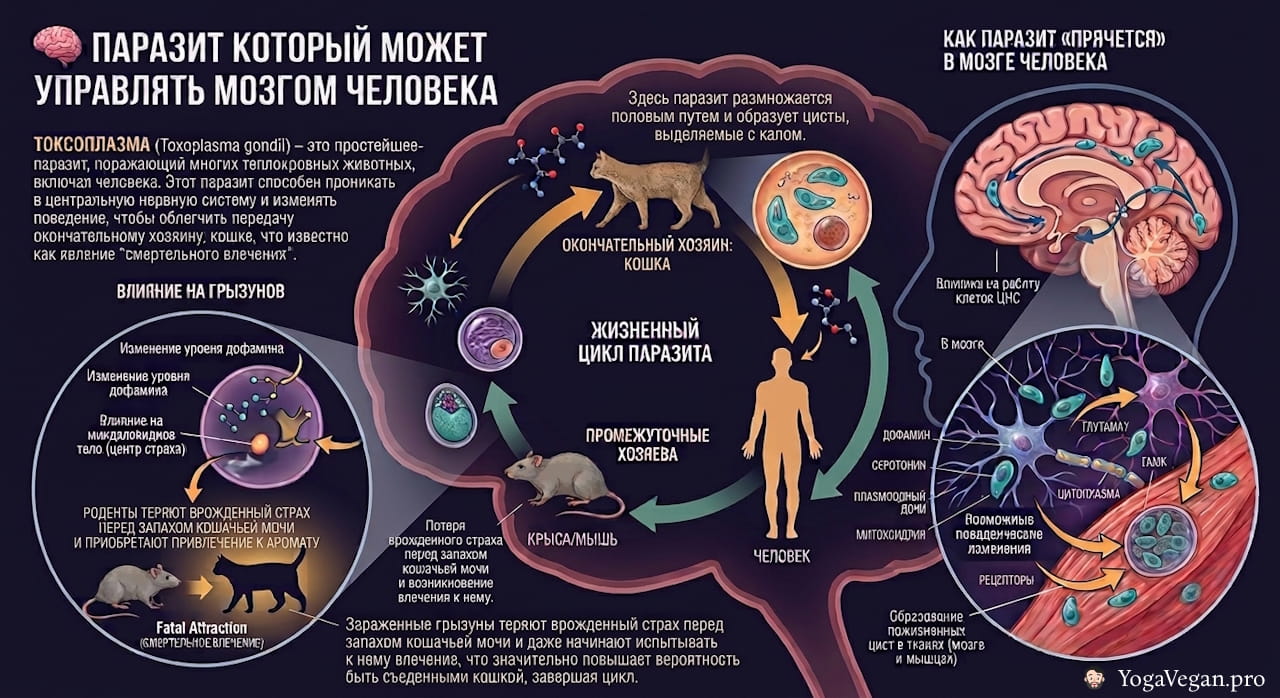
🧠 The parasite that can control humans
Toxoplasma (Toxoplasma gondii) is a protozoan parasite that changes the behavior of its intermediate hosts. Usually rodents, to ease its path to the definitive host — the cat. But they also live freely in animals and in humans.
In the brain of infected rodents, the parasite changes dopamine levels and affects the amygdala (the fear center). Because of this, rodents lose their innate fear of the smell of cats and begin to feel "attraction" to it, and may come out to a cat, which increases the likelihood of being eaten and completing the parasite's life cycle. This phenomenon is called "fatal attraction." The parasite can reproduce only in the intestines of felines. Therefore, it is "beneficial" for it that the infected rodent be eaten by a cat.
A major 2025 meta-analysis combining data from 320 studies from 113 countries estimates global infection at 36.2% (with a range of 34.1–38.4%). Every third person on Earth has traces of these parasites!
🕵️ How the parasite "hides" in the human brain
Toxoplasma affects not only mice and cats but also other animals, including the human brain, and scientific interest in its effect on behavior and psyche grows every year. After the acute stage of toxoplasmosis, the parasite does not disappear but forms cysts in tissues (primarily in the brain and muscles) that persist for life. Being inside the cells of the central nervous system, the parasite can influence their function through several mechanisms.
🔥 Neuroimmune inflammation
The presence of cysts causes chronic activation of brain immune cells (microglia, astrocytes) and the release of pro-inflammatory cytokines. This can disrupt connections between neurons and contribute to neurodegeneration.
⚖️ Neurotransmitter imbalance
The parasite interferes with metabolism critical for mood and thinking:
- Dopamine: Toxoplasma is able to raise its level, which is linked to behavioral changes (e.g., reduced anxiety).
- Serotonin: Immune activation causes depletion of tryptophan — the "building material" for serotonin, which can lead to depressive states.
- Norepinephrine: There is data that the parasite suppresses the enzyme necessary for norepinephrine synthesis, which can impair concentration and stress regulation.
⚠️ Acute harm: toxoplasmic encephalitis in people with weakened immunity
The harm that toxoplasma can cause to the brain varies greatly depending on the state of the human immune system. For people with weakened immunity, it can be a destructive and life-threatening infection, whereas in people with healthy immunity the parasite usually causes a latent infection whose consequences remain the subject of active study.
In people with a weakened immune system, toxoplasma can cause toxoplasmic encephalitis — a dangerous inflammation of the brain:
- Mechanism of damage: The parasite actively multiplies in brain tissues, causing focal necrosis (tissue death). Pathologically this manifests as characteristic lesions with three zones: central necrosis, intermediate zone, and inflamed outer zone.
- Consequences: This leads to serious neurological symptoms such as headaches, confusion, seizures, and focal neurological deficits. Without treatment, this condition can be fatal.
🦠 Hidden harm: latent infection and its link to disorders
In people with normal immunity, the acute infection is usually suppressed, but the parasite does not disappear completely. It forms cysts in the brain that can persist for life. Although this latent stage is considered "asymptomatic," growing research links it to a number of neurological and psychiatric problems.
🔗 What conditions are linked to latent infection
Scientific reviews point to a statistical association (not necessarily direct causation) between chronic toxoplasma infection and increased risk of:
- Psychiatric disorders: Schizophrenia, bipolar disorder, major depression, aggressive behavior, anxiety disorders, and suicide attempts.
- Cognitive impairments: Decline in memory and psychomotor reactions, especially in older people.
- Neurodegenerative diseases: Alzheimer's disease (considered a possible risk factor).
- Behavioral changes: The already mentioned "fatal attraction phenomenon," as well as an increased risk of traffic accidents.
📝 Conclusion
Toxoplasma is a parasite capable of exerting a multi-level effect on the human brain, from dangerous acute damage to hidden but potentially significant long-term changes. The main thing that protects us from danger is our immunity, which depends on health. In any case, it is necessary to help the body and cleanse oneself of various parasites. They affect not only our health but also our behavior, our thoughts, and our anxiety.
To get more information about parasites, I recommend watching the amazing Soviet research: 🎬 Academician Skryabin Konstantin Ivanovich on parasites, helminths 🪱
And what to do about it is well explained in this video by doctor-professor Ashot Papikovich Khachatryan: 🎬 The doctor shocked by telling the truth about fish 🐟
Video on the same topic: 🎬 Toxoplasma — the parasite of the psyche: how toxoplasmosis affects human behavior 🧠
📚 Sources of information for this article
📊 Prevalence
- Salari N, 2025 — BMC Pregnancy Childbirth (PubMed)
- Bigna JJ, 2020 — Parasit Vectors (PubMed)
🧠 Mechanisms of influence on the brain
- Sun H, 2026 — Brain Behav Immun (PubMed)
- Hsu PC, 2014 — J Am Assoc Nurse Pract (PubMed)
- Alsaady I, 2019 — Infect Immun (PubMed)
- Stibbs HH, 1985 — Ann Trop Med Parasitol (PubMed)
- Mahmoud ME, 2017 — Infect Immun (PubMed)
⚠️ Encephalitis in immunodeficiency
- Tahiliani S, 2025 — J Assoc Physicians India (PubMed)
- Van Den Noortgate R, 2023 — Case Rep Transplant (PubMed)
🧬 Link to disorders
- Oncu-Oner T, 2022 — Ann Parasitol (PubMed)
- Montazeri M, 2023 — PLoS One (PubMed)
- Wang J, 2024 — J Alzheimers Dis (PubMed)
- He Z, 2026 — J Neuroinflammation (PubMed)