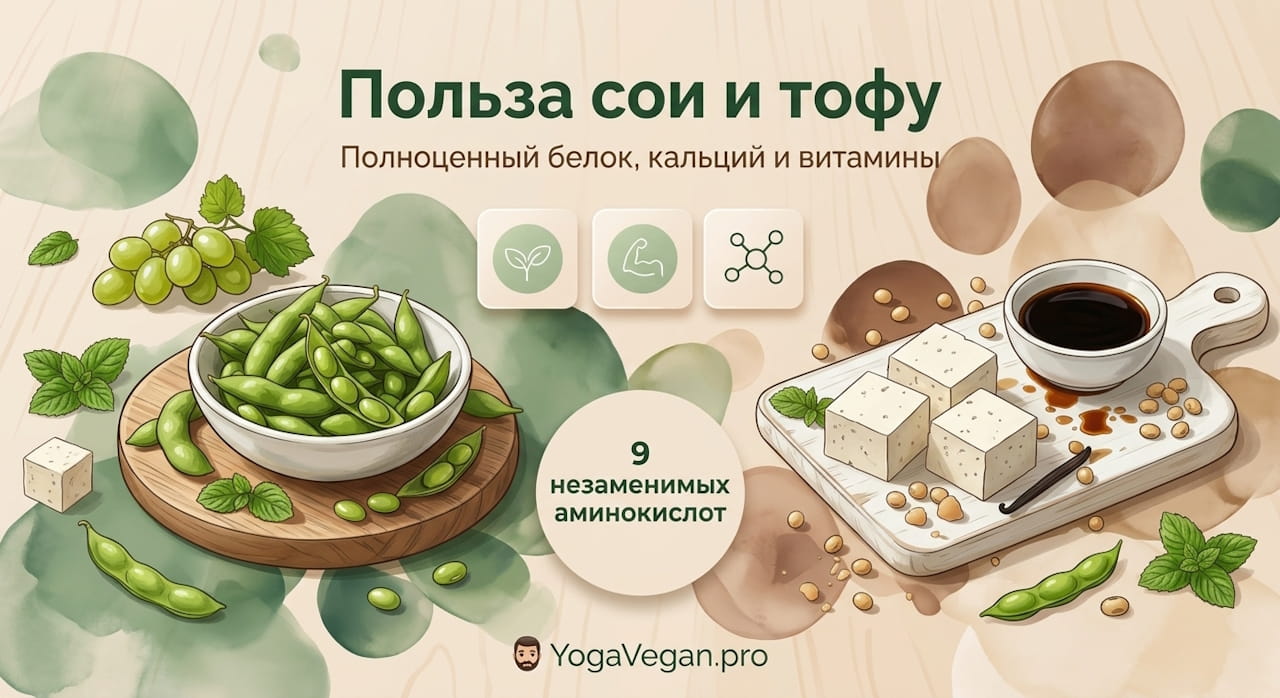
🫛 Soy and tofu are excellent sources of all essential amino acids
Soy and tofu are excellent sources of all essential amino acids, and tofu is also a source of calcium. Green soybeans (often called edamame) (like any other whole soy products) contain all 9 essential amino acids in sufficient quantities. This makes soybeans complete protein sources, which is not so common among plant products (most grains and legumes individually are deficient in one or two amino acids).
Green soybeans in pods, most often sold as edamame, differ noticeably in composition from firm tofu. If tofu is a concentrated source of calcium and protein, then edamame is a real treasure trove of vitamins, especially B vitamins, and fiber.
Nutrients per 100 grams of cooked edamame beans (as a percentage of the daily value):
- Protein: 11.5–12 g — 21–23% of the daily value.
- Fiber: 5–5.2 g — 18–26% of the daily value.
- Vitamin B9 (folate): 286–311 mcg — 72–78% of the daily value.
- Vitamin B1 (thiamine): 0.18–0.2 mg — 15–17% of the daily value.
- Vitamin K: 26.7–31.4 mcg — 22–26% of the daily value.
- Manganese: ~1 mg — 44–50% of the daily value.
- Copper: 0.3–0.33 mg — 30–38% of the daily value.
- Phosphorus: 164–169 mg — 23–24% of the daily value.
- Iron: 2.1–2.3 mg — 12–23% of the daily value.
- Magnesium: 62–64 mg — 15–16% of the daily value.
- Potassium: 436–482 mg — 9–12% of the daily value.
- Calcium: 60–63 mg — 5–6% of the daily value.
🍲 TOFU
Like soy, tofu is considered a complete balanced protein source, as it contains all 9 essential amino acids necessary for the body, and also contains a huge amount of calcium. Healthy tofu is made from just 3 ingredients: water, soy, and calcium sulfate (a mineral salt found in plants).
Content of key nutrients in 100 grams of such tofu:
- Protein: 17.27 g — 23–34% of the daily value (depends on weight and activity level).
- Fiber: 0.3–0.5 g — 1–2% of the daily value.
- Vitamin B9 (folate): 29 mcg — 7% of the daily value.
- Vitamin B1 (thiamine): 0.158 mg — 13% of the daily value.
- Vitamin K: data absent (some sources indicate about 2–3 mcg, which is 2–3%).
- Manganese: 0.7–1.18 mg — 29–51% of the daily value.
- Copper: 0.38 mg — 42% of the daily value.
- Phosphorus: 190 mg — 24% of the daily value (for adults).
- Iron: 2.66 mg — 15–27% of the daily value (depends on sex: 27% for men, 15% for women).
- Magnesium: 58 mg — 15% of the daily value.
- Potassium: 237–266 mg — 5–9% of the daily value.
- Calcium: 683 mg — 53–68% of the daily value.
🧂 About the salt — calcium sulfate (CaSO₄) in tofu.
Calcium sulfate acts as a "coagulant" for soy milk and is simultaneously a source of calcium, which significantly increases the nutritional value of the finished product.
Calcium sulfate is recognized as safe for use in food products. Its use in food does not raise safety concerns. It does not require establishing a numerical acceptable daily intake (ADI). Its safety is confirmed by authoritative organizations: EFSA (European Food Safety Authority), the EU Scientific Committee on Food.
This salt is a mineral. It precipitates when seawater evaporates and is often part of other salts, such as sea and rock salt. Although it is unlikely to be seen in table or sea salt, it is present in unrefined sea salt and some types of natural salt as one of the micro-minerals.
🧪 What if the SOY IS GMO?
Contrary to popular belief, non-GMO soy is mostly used for food and for producing tofu and products for people. According to the US Food and Drug Administration (FDA), most GM soy is used specifically for producing animal feed, for technical needs, for soybean oil and other derivatives (e.g., lecithin) used as ingredients.
It can be confidently said that a person who is panically afraid of GM soy but regularly eats meat, sausages, semi-finished products, and uses vegetable oil for frying demonstrates a vivid example of cognitive dissonance in matters of nutrition. To fear GM soy in a piece of pure tofu but calmly eat cheap sausage or fried chicken is irrational.
The bulk of GM soy (up to 70–80% of the US harvest) goes to livestock feed. This means that when you eat:
- Beef, pork, chicken, and fish raised on conventional farms (not organic), you are essentially "consuming" GM soy in concentrated form. The animal ate tons of it over its life, and all its proteins and metabolites passed through its body. Feed soy is grown for maximum yield and oil content. Its taste qualities for humans are unimportant. It may contain more oligosaccharides that cause gas, and less attention is paid to preserving native protein since it is processed or fed to animals anyway. In general, animals are given the cheapest, often chemical food, enriched with hormones, antibiotics, and other nastiness, and all of this remains in their corpses after they are killed for eating.
- Processed products and meat. Most soy lecithin (emulsifier E322), soybean oil, and vegetable protein (textured), which are added to sausages, frankfurters, canned goods, baked goods, and sauces, are produced specifically from cheap GM soy. Here it is present as an ingredient directly. Meat and processed products from cheap raw materials are high in saturated fats, salt, preservatives, nitrites (in sausages), and advanced glycation end products formed during frying. These factors influence the risk of cardiovascular diseases and oncology thousands of times more strongly than the presence of transgenic protein.
Soy varieties for tofu production and varieties for livestock feed are completely different categories from a breeding standpoint. Soy for tofu is grown from special varieties with larger beans, high protein content, and a neutral, slightly sweet taste. Strict requirements are imposed on it regarding purity and organoleptic properties.
This is just one of the good examples of healthy whole food rich in proteins, calcium, vitamins, and other microelements, and there are more in plant nutrition.