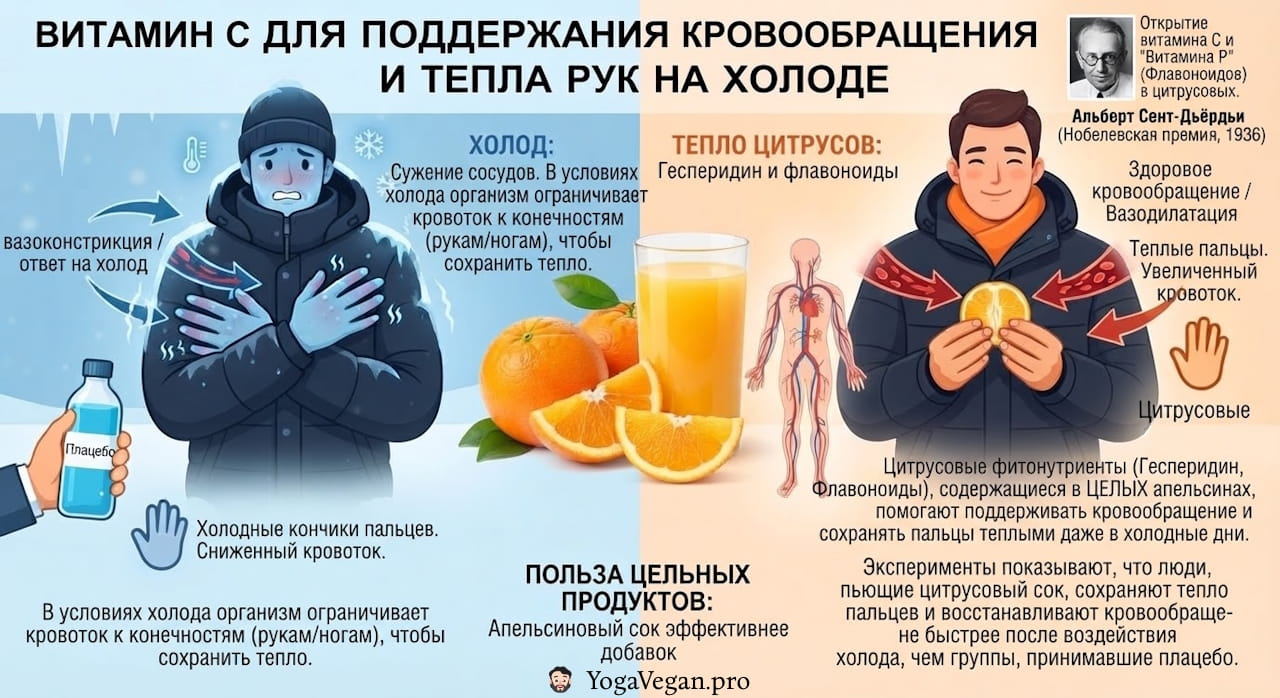
🍊 Vitamin C for maintaining blood circulation and warmth of hands in the cold
Many people know vitamin C as a remedy for colds, but there is a lesser-known property of it — its effect on blood circulation in the extremities. And here there is an important nuance: we are not talking about vitamin C itself in tablets, which does not work, but about citrus phytonutrients.
🍊 The story begins with a Nobel laureate
In 1936, Albert Szent-Györgyi, who received the Nobel Prize for the discovery of vitamin C, described another substance — "vitamin P." Today we know it as the class of flavonoids — phytonutrients of which there are thousands.
One of them — hesperidin — is found mainly in citrus fruits. It is this, according to research, that helps maintain blood flow in the fingers.
🧪 What the experiments showed
Researchers took volunteers with increased sensitivity to cold (their hands and feet were cold) and placed them in a room with air conditioning. Participants drank either a placebo (a drink like "orange Kool-Aid") or a drink with real citrus phytonutrients in two doses.
Results:
- In the placebo group, finger temperature fell by almost 5°C and continued to decrease.
- In those who received citrus phytonutrients (in any dose), blood flow remained stable, and the fingers did not cool as much.
Additionally: when participants immersed their hands in cold water, in the citrus group finger temperature returned to normal faster.
🔬 How it works
When we are in the cold, the body constricts peripheral vessels to preserve heat for internal organs. Hesperidin (and possibly other citrus flavonoids) helps maintain blood flow in the extremities, preventing this "shutdown" of the fingers.
The effect of whole orange juice turned out to be stronger than that of isolated hesperidin. Juice affects the expression of about 3,000 genes, while pure hesperidin affects only 2,000. This once again confirms the main principle: whole products work better than isolated supplements.
⚠️ Important warning
Vitamin C in tablets is not the same thing. Moreover, high doses of vitamin C supplements (from 1000 mg) can increase the risk of kidney stones in men — from about 1 case per 600 people per year to 1 per 300. We are talking specifically about citrus fruits as a product, not about supplements, which often bring more harm than benefit.
🍊 Practical conclusion
If your hands get cold in the cold — perhaps it is worth leaning on oranges, mandarins, grapefruits (and even the peel, where the concentration of flavonoids is maximal). This is not a panacea and does not replace warm gloves, but maintaining blood circulation in the fingers is quite realistic.
And once again: eat oranges, do not swallow vitamin C in tablets!
Source: 📚 "How Not to Die: Food in the Fight for Life" - Michael Greger