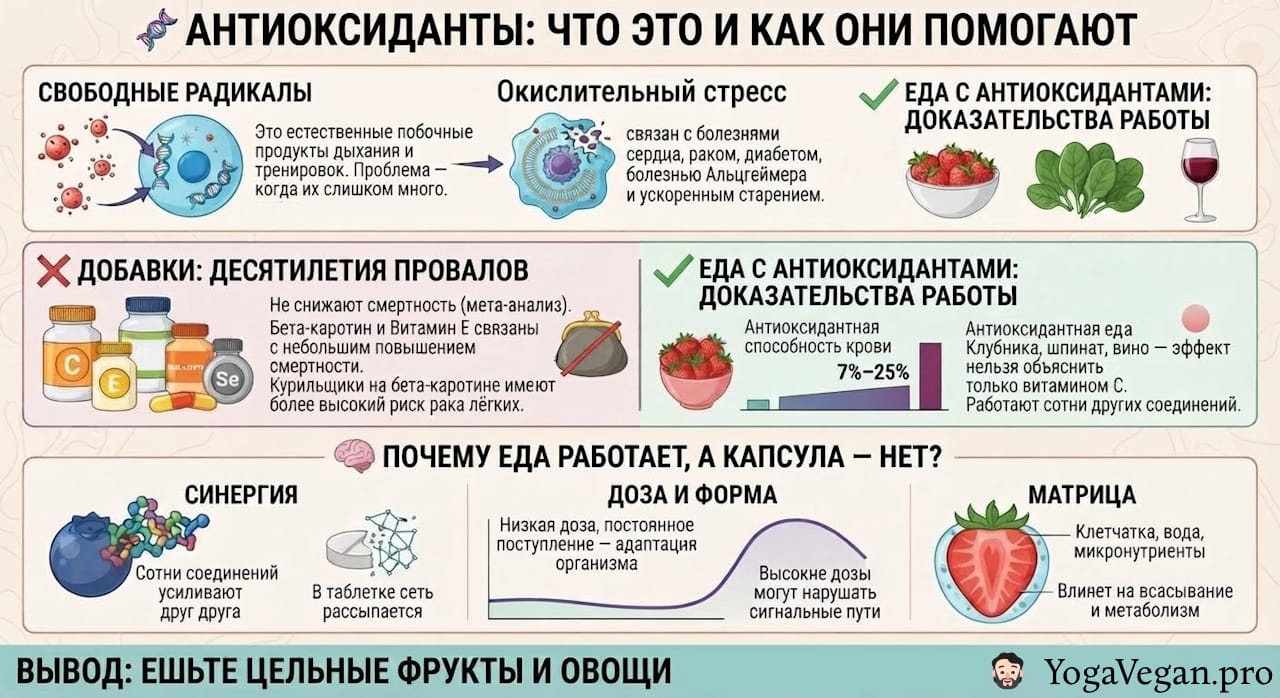
🧬 Antioxidants: what are they and how do they help
Antioxidants are molecules that protect our cells from damage by reactive oxygen species — free radicals.
Free radicals — are formed naturally during breathing, digesting food, training, and are even needed by the immune system to destroy viruses and bacteria. The problem begins when there are too many of them — then they begin to damage DNA, cell membranes, and the intercellular space. This state is called oxidative stress.
Oxidative stress is associated with cardiovascular diseases, cancer, diabetes, Alzheimer's disease, and accelerated aging. Oxidation is one of the key causes of aging.
We have heard hundreds of promises: "antioxidants slow aging," "remove free radicals," "protect against cancer." But the more clinical studies are conducted, the clearer one thing becomes — the effectiveness of antioxidants almost entirely depends on the form in which they enter the body.
❌ Supplements: decades of clinical failures
Vitamin C, vitamin E, beta-carotene, selenium — the most popular antioxidant supplements. All of them have undergone serious clinical trials. The result is sobering:
- A meta-analysis of quality studies showed: antioxidant supplements do not reduce mortality — neither in healthy people nor in patients with diseases.
- Beta-carotene and vitamin E in supplement form are associated with a small but significant increase in mortality.
- In smokers who took beta-carotene, the risk of lung cancer turned out to be higher than in those who took placebo.
Commercial supplements are useless for improving one of the key systems of aging — oxidative stress. People spend large sums on serums with vitamin C for the skin, although the same money spent on real food would give an effect that is "2000 times cheaper."
✅ Food with antioxidants: evidence of work
A completely different picture — with whole plant products.
In a 1998 study, elderly women were given either strawberries (240 g), or spinach (294 g), or red wine (300 ml), or vitamin C (1250 mg). After 4 hours the total antioxidant capacity of the blood was measured. All four options worked — the increase was from 7% to 25%.
But the key nuance: the effect of strawberries and spinach could not be explained only by the vitamin C contained in them. This means that in whole products hundreds of other compounds work — phenolic acids, flavonoids, anthocyanins. It is this synergy that is the reason why food works and a capsule does not.
🧠 Why does food work and a capsule does not?
There is still no exact answer, but the key mechanisms are known:
- Synergy. In one blueberry — hundreds of phytochemical compounds. They enhance each other's absorption and action. Isolate one substance into a tablet — and the network falls apart.
- Dose and form. In food the concentration of antioxidants is lower than in supplements. But it is "low dose, constant intake" that corresponds to what the body has adapted to over tens of thousands of years. High doses can disrupt normal redox signaling pathways.
- Matrix. In food antioxidants exist together with fiber, water, and other micronutrients. This "packaging" affects the rate of absorption and metabolism.
The conclusion is simple: if you want to get the benefit of fruits and vegetables — eat fruits and vegetables.
🫐 Berries — protection of the brain and vessels
Michael Greger includes berries in his "eight for longevity." He refers to studies showing that berries and green tea protect the brain from cognitive decline with age. This is not an abstract "cleansing of radicals" but measurable preservation of functions.
Blueberries — one of the most studied products in the context of antioxidants.
- Half a cup of blueberries added to breakfast slows the fall of antioxidants in the blood.
- A quarter cup no longer works — there is a clear dose threshold.
- Six-week intervention: in people who drank blueberry smoothie twice a day, the level of free radicals in the blood fell by half.
A randomized double-blind 2023 study (American Journal of Clinical Nutrition): in healthy elderly people who received the equivalent of 302 mg of anthocyanins from freeze-dried wild blueberries, vascular function and cognitive indicators improved. This is not a test tube and not mice — these are real people with measurable improvements.
🧅 Onions, apples, kale — against "zombie cells"
"Zombie cells" cause inflammation and age-related diseases. Products rich in quercetin — onions, apples, and kale — help cleanse the body of them.
🍄 Mushrooms and tempeh — support of autophagy
Autophagy is "garbage recycling" inside cells. The compound spermidine, found in tempeh, mushrooms, and wheat germ, helps launch this process.
I described autophagy in more detail in my experience of 21 days of fasting on water: 🧘 My experience of 21 days of fasting only on water
🌿 Plant food in general
Diet can regulate each of the eleven pathways of aging. This means that protection from oxidation is not about one molecule but about the entire diet rich in plant products.
💰 Simple arithmetic
Vitamin C in the form of a face serum costs 2000 times more than the same obtained from food. The meaning is simple: do not pay for isolates, pay for products.
⚠️ Regarding "antioxidants cause cancer"
On the internet you can find scary headlines. The answer to them: those studies used isolated high-dose pharmacological forms (e.g., N-acetylcysteine), not antioxidants from food.
"Antioxidant supplements cannot effectively replace real vegetables. In fact, lutein capsules were associated with an increased risk of lung cancer" - Michael Greger
The problem was never with antioxidants as such. The problem is in their form and dose.
💡 Summary
Antioxidants are not a substance that can be put into a capsule. This is a defense system that works only when you eat whole plant products — berries, onions, apples, kale, mushrooms — every day.
- Add antioxidants to every meal. After stress the antioxidant status of the blood falls within 2 hours and recovers within up to 3 days. Consistency is more important than a one-time large dose.
- Bet on berries. Blueberries, blackberries, strawberries, raspberries — high content of anthocyanins, strong evidence base.
- Do not chase "superfoods". Spinach, kale, onions, apples, nuts work no worse. It is recommended to eat products with quercetin (onions, apples, kale) to support cleansing from aging cells.
Spend money on food, not on capsules. This is perhaps the main thing!
Source: 📚 "How Not to Die: Food in the Fight for Life" - Michael Greger