🥣 Oatmeal superfood: what does science say?
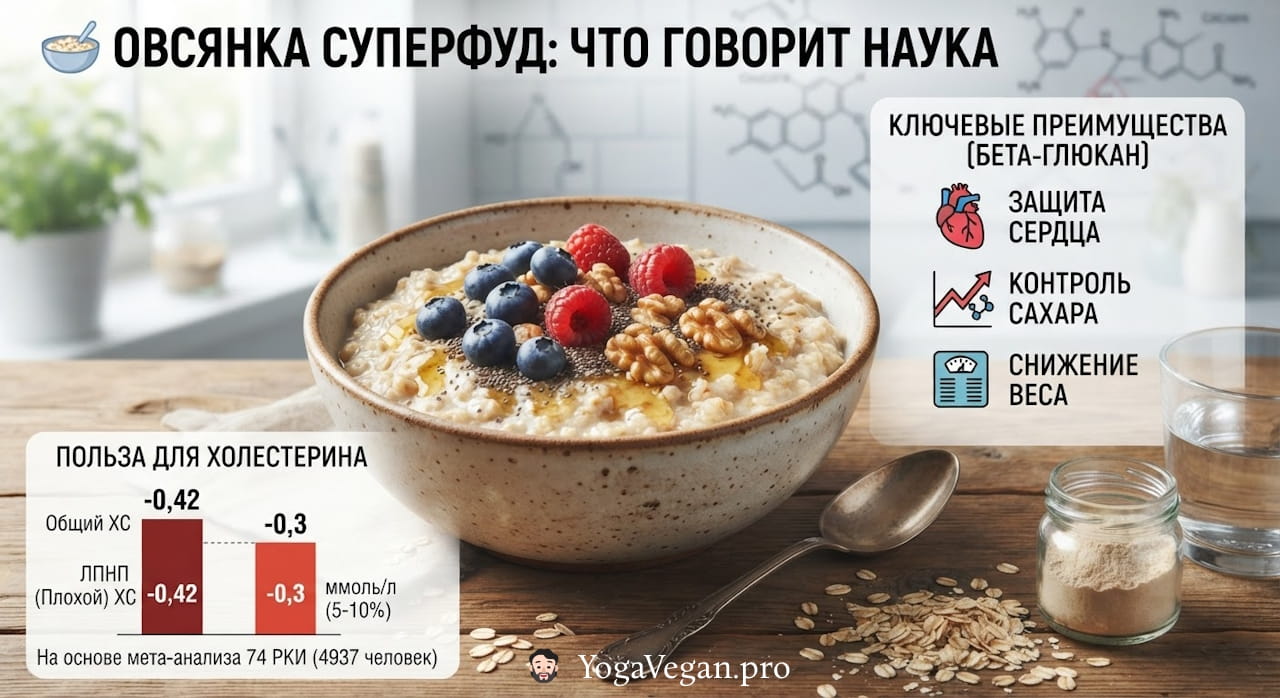
Oatmeal (oats) is one of the most nutritious grains, which is a superfood. Its key component, beta-glucan, has a serious evidence base for heart protection, blood sugar control, and weight loss. It lowers blood cholesterol levels and renews bile, preventing the formation of gallstones.
If you eat 100 g of oatmeal daily, the cholesterol reduction on average will be: total by 0.42 mmol/L, and LDL ("bad" cholesterol) by about 0.3 mmol/L, or by 5–10% of the initial level. This is data from a meta-analysis of 74 randomized controlled trials with 4937 participants.
🌾 Composition of oatmeal
- 🫘 Protein. 9–17% — one of the highest indicators among grains. Moreover, oats are rich in lysine — an amino acid that other cereals usually lack.
- 🫒 Fats. About 5.8% — almost twice as much as in buckwheat. And these are predominantly healthy unsaturated fatty acids (oleic, linoleic).
- 💧 Beta-glucan. Here is the main hero. This is water-soluble fiber, of which oats contain 3–8%, while wheat — only 0.5–1%. Once in the intestine, beta-glucan forms a gel. Almost all the beneficial effects of oats are associated with this gel. It reduces the content of bad cholesterol in the blood and prevents the appearance of gallstones.
- ⚡️ Microelements. Magnesium, phosphorus, calcium, iron, zinc, manganese. Plus B vitamins (especially B1 and biotin), E, PP.
- 🛡 Avenanthramides. Unique antioxidants that are found almost only in oats and have antioxidant activity 10–30 times higher than other grain phenols:
- Prevent oxidation of "bad" cholesterol — work synergistically with vitamin C, enhancing this protection
- Suppress inflammation in vessels, blocking the NF-kB factor associated with the formation of atherosclerotic plaques
- Improve vascular function, promoting the production of nitric oxide, which dilates vessels and improves blood flow
- Relieve itching and skin irritation — the action of colloidal oatmeal is based on this
📊 Numbers: what 100 g of oat flakes gives
Below is the content of key nutrients in 100 g of dry oat flakes and in parentheses the percentage of the daily value for an adult.
- Macronutrients: Kcal 379 (19%) • Protein 13.15 g (26%) • Fats 6.52 g • Carbohydrates 67.7 g • Fiber 10.1 g (40%) • Starch 57.9 g • Sugar 0.99 g
- Fatty acids: Oleic (omega-9) ~2.2 g (8%) • Linoleic (omega-6) 2.5 g (15–25%) • Alpha-linolenic (omega-3) 0.13 g • SFA 1.2 g • MUFA 2.4 g • PUFA 2.5 g
- Minerals: Phosphorus 410 mg (59%) • Magnesium 138 mg (33%) • Iron 4.25 mg (24–55%) • Zinc 2.5–4 mg (26–40%) • Manganese ~3.6 mg (158%) • Copper 0.28–0.4 mg (43%) • Selenium 18–28.9 mcg (53%) • Calcium 52 mg (5%) • Potassium 260–362 mg (8%) • Sodium 3 mg • Molybdenum 110 mcg
- Vitamins: B1 (thiamine) 0.45 mg (30%) • B3 (niacin) 1.1 mg (7%) • B5 (pantothenate) 1.29 mg • B6 0.11–0.2 mg (10%) • B9 (folate) 30 mcg (8%) • Biotin (B7) 22 mcg (44%) • E 0.6–0.72 mg (5%)
- Beta-glucan: 3.6–4 g (120% of the recommended 3 g/day)
📊 What this means in practice.
One serving of oatmeal (40–50 g of dry flakes) gives:
- ~50% of the daily norm of phosphorus — a mineral critical for bones and energy metabolism
- 15–25% magnesium — for the nervous system and muscles
- 10–20% iron — non-heme iron. Vitamin C (berries, orange) improves absorption
- ~10–15% vitamin B1 — for carbohydrate metabolism and the work of the nervous system
⚠️ Important note. The figures are for dry flakes. When boiled in water, calories and nutrients are "diluted": 40 g of dry flakes turn into approximately 200–250 g of ready porridge.
🔬 What is confirmed by research
- ❤️ Heart protection — the strongest position. A randomized controlled study on Chinese adults with high cholesterol showed: replacing 100 g of other carbohydrates with oat flakes daily for 6 weeks reduced total cholesterol by 6.2%, "bad" LDL — by 8.4%, and also reduced waist circumference. Each 1% reduction in LDL gives a 1–3% drop in the risk of coronary heart disease.
- 🩸 Sugar control and satiety. Low glycemic index plus the viscosity of beta-glucan slow gastric emptying and glucose absorption. This helps smooth sugar spikes after meals — especially relevant for people with prediabetes and type 2 diabetes.
- 🦠 Digestion and intestines. Oat fiber works in two directions: gently stimulates peristalsis in constipation and simultaneously feeds beneficial microflora. Beta-glucan is a prebiotic, that is, food for good bacteria.
- 🪨 Oatmeal and gallstones. Studies show oatmeal changes the composition of bile (reduces cholesterol saturation) and reduces the risk of gallstone formation. Mechanism: beta-glucan binds cholesterol and bile acids in the intestine, the liver spends cholesterol on synthesizing new acids — and there is less of it in bile. Less cholesterol in bile → lower risk that it will precipitate and form a stone.
- ⚖️ Weight. The combination of protein, fats, and soluble fiber gives a long-lasting feeling of satiety. Studies show that people who regularly eat oatmeal for breakfast consume fewer calories.
- ✨ Skin. Zinc and antioxidants participate in the regulation of inflammation — hence the popularity of oats in the care of problem skin.
📌 What you need to know
- ⚠️ Quick-cooking flakes are not the same thing. The more processed the grain, the higher the glycemic index. Heat treatment destroys part of the avenanthramides, so the least processed flakes and bran contain more of them. "Oatmeal in 1 minute" can raise sugar almost like white bread. The optimal choice is whole grain or large flakes requiring 10–15 minutes of cooking.
- 🍬 Sugar and additives. Many ready-made porridges contain sugar, syrups, dried fruits, and flavorings that kill all the benefits. Read the composition.
- 🧪 Phytic acid. Like all grains, oats contain phytates that worsen the absorption of iron and zinc. Soaking or boiling significantly reduces their content to a minimum.
🍽️ How to eat oatmeal correctly
- 🌾 Choose whole grain or large flakes — not "instant," cook on low heat for at least 15 minutes so that all the benefits are released.
- 🫘 Combine with protein and fats — nuts, seeds, coconut yogurt. This reduces the glycemic response and prolongs satiety.
- 🍓 Add berries, not sugar — antioxidants plus fiber.
- 🛡 Oatmeal is an excellent antioxidant + the king of antioxidants — cinnamon
Antioxidants protect cells from oxidative stress — damage to DNA, membranes, and proteins by free radicals, which leads to cardiovascular diseases, diabetes, and accelerated aging: 🧬 Antioxidants: what are they and how do they help
100 g of oatmeal has an antioxidant capacity of approximately 100 to 858 mcmol TE. The coarser the processing (e.g., polished oats, bran), the higher the antioxidant capacity; for steam-treated oats the capacity decreases since part of the antioxidant components is heat-sensitive.
Oatmeal alone is an excellent antioxidant, and adding half a teaspoon (≈1.3 g) of cinnamon to oatmeal increases the total antioxidant content by more than 5 times, which is more than in 100 g of oatmeal.
The antioxidant density in spices is hundreds of times higher than in grains. And cinnamon not only is an antioxidant itself but also improves the taste of oatmeal.
Antioxidants do not work alone. They restore each other. For example, glutathione "revives" vitamin C, and it helps vitamin E recover.
Oatmeal provides one group of antioxidants (avenanthramides, tocopherols, phenolic acids), cinnamon — another (polyphenols, cinnamic acid, eugenol). Together they cover a wider spectrum of free radicals than each separately.
Limitation: cinnamon contains coumarin, it is not recommended to exceed 1 teaspoon per day for a long time.
📝 Summary
Oats earned superfood status not by marketing but by research. Beta-glucan is a rare example of a component that simultaneously improves the lipid profile, stabilizes sugar, feeds the microbiome, and helps control weight. But the benefit depends on what exactly you eat: whole grain and large flakes — yes, sweet quick-cooking porridges — no.
Other gluten-free super grains: 🌾 Top 3 grains for gluten-free health
📚 Sources
- Macronutrients: FatSecret, Fineli, Myllyn Paras
- Vitamins and minerals: FitAudit, My Healthy Diet, Bruggen
- Beta-glucan: Scientific article (2012) — 3.67% β-glucan in flakes; review in a medical journal — 1.8–7%
- Cholesterol and bile: Ho HV et al. (2016); Lia A et al. (1995); Zhang JX et al. (1994); Zhang J et al. (2012)
- Avenanthramides: Perrelli A et al. (2018); Meydani M. (2009); Wang C et al. (2019); Koenig R et al. (2014)