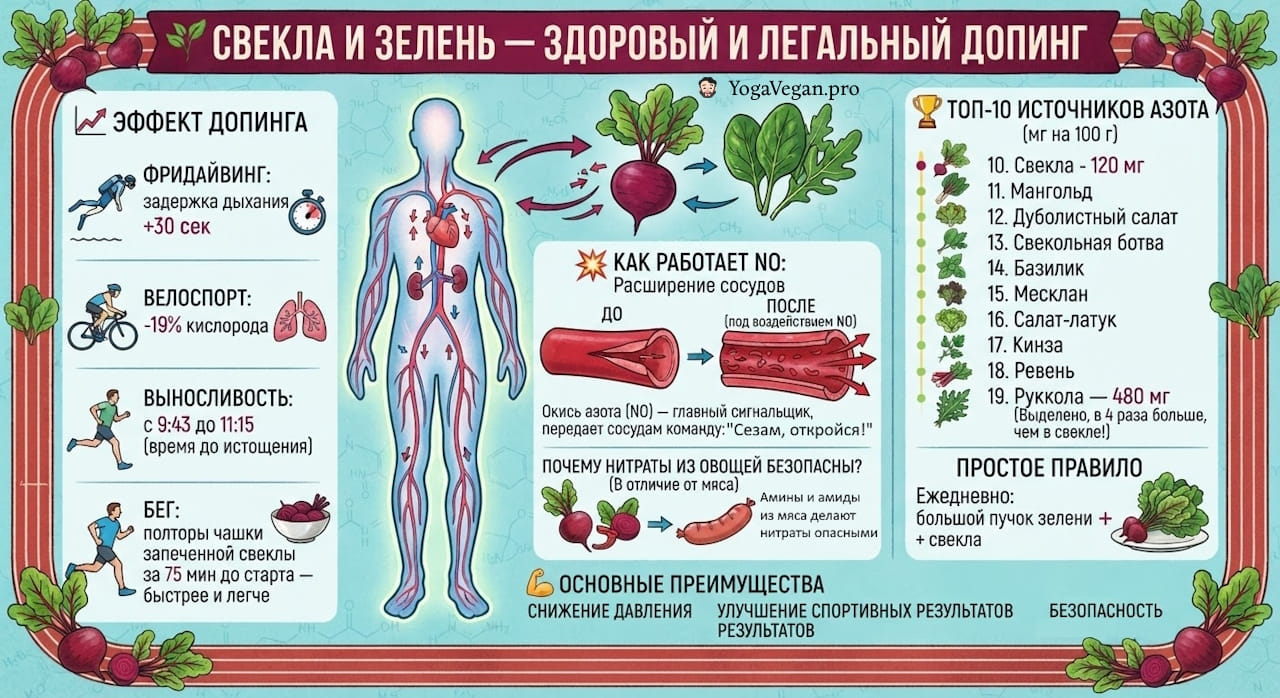
🍠 Beets and greens - healthy and legal doping
Beetroot (table beet) is one of the key products for the prevention of cardiovascular diseases and improving physical performance. The main value of beets and greens is due to the high content of substances that turn into nitric oxide (hereinafter — NO).
📈 Beets work like doping
- Freedivers hold their breath 30 seconds longer
- Cyclists spend 19% less oxygen
- Time to exhaustion: from 9:43 to 11:15
Dose: half a cup of juice (or 3 small beets, or a cup of spinach) 2–3 hours before exercise.
💥 The power of NO: why beets and greens are "legal doping"
Nitric oxide (NO) is the main signaler in our body. It transmits the command "Open Sesame!" to the vessels — and more blood rushes through them, carrying more nutrition and oxygen to our cells, increasing our endurance and strength. This is exactly how nitroglycerin works: it turns into NO, dilates the coronary arteries, and saves from chest pain. Erectile dysfunction pills (Viagra) act in a similar way — they enhance the NO signal.
🥬 Greens and beets — sources of nitrogen
Half a glass of beet juice lowers systolic pressure by 8 points in 4 weeks (2015 study funded by the British Heart Foundation).
🏆 Top-10 sources of nitrogen (ascending)
- Beets 120 mg of nitrogen per 100 g — 40% of the daily value of 300 mg
- Chard — 102% of the norm
- Oakleaf lettuce — 33% of the norm
- Beet tops
- Basil — 79%–1427% of the norm
- Mâche
- Lettuce — 40% of the norm
- Cilantro
- Rhubarb — 98% of the norm
- Arugula — 480 mg of nitrogen per 100 g — 160% of the daily value, 4 times more than in beets!
Simple rule: eat a large bunch of salad every day and beets. NO supplements — scientifically proven to be dubious and do not work properly, causing many side effects.
💪 Main benefits of beets
- Lowering blood pressure: Nitrates contained in beets are converted in the body into nitric oxide (NO), which dilates blood vessels. Studies have shown that in volunteers who drank beet juice, systolic pressure decreased by about 10 units within a few hours, and the effect persisted throughout the day. In the chapter on hypertension, Greger cites data that regular consumption of beet juice (for example, one cup a day for four weeks) can consistently lower pressure.
- Improving athletic performance: Beets help muscles use oxygen more efficiently. Greger refers to studies where one serving of beet juice allowed freedivers to hold their breath about 30 seconds longer, and cyclists performed the same load while consuming 19% less oxygen. During intensive training, time to complete exhaustion increased from 9:43 to 11:15. This makes beets popular among athletes as "legal doping."
- Effectiveness of whole beets: Whole beets work just as well as juice. For example, 75 minutes before a 5 km race, consumption of 1.5 cups of baked beets (about a can) allowed participants to run the last mile faster and with less fatigue than the control group, while their heart rate did not increase.
- Safety and nuances: Nitrates from whole vegetables are safer than synthetic supplements or "NO boosters," whose effectiveness is often unproven. He also mentions beeturia (pink urine after beets) as a harmless confirmation of phytonutrient absorption. As for oxalates, which can bother people with kidney stones, Greger points out that in beets their bioavailability is relatively low (6 times less than in spinach), and boiling reduces their content by about 25%.
It is not nitrates themselves that are dangerous but their conversion into nitrosamines. This requires amines and amides — and they are abundantly present in animal products. The conversion can occur both in the meat itself and in your stomach.
When you eat plant food, vitamin C and other antioxidants contained in it block the formation of carcinogens in your body. That is why: meat products are linked to kidney cancer, while nitrates and nitrites from plant sources are not. Beets, arugula, and spinach are not the same as sausage and bacon, even if the chemical formulas are similar.
📝 Recommendations
Although beets are an excellent source of nitrates, in the list of products with their high content they are inferior to some leafy vegetables. For example, arugula contains about 4 times more nitrates per 100 g than beets. Therefore, Greger recommends including beets in the diet as part of diverse nitrate-containing vegetables, along with leafy greens (spinach, arugula, chard).
Source: 📚 "How Not to Die: Food in the Fight for Life" - Michael Greger