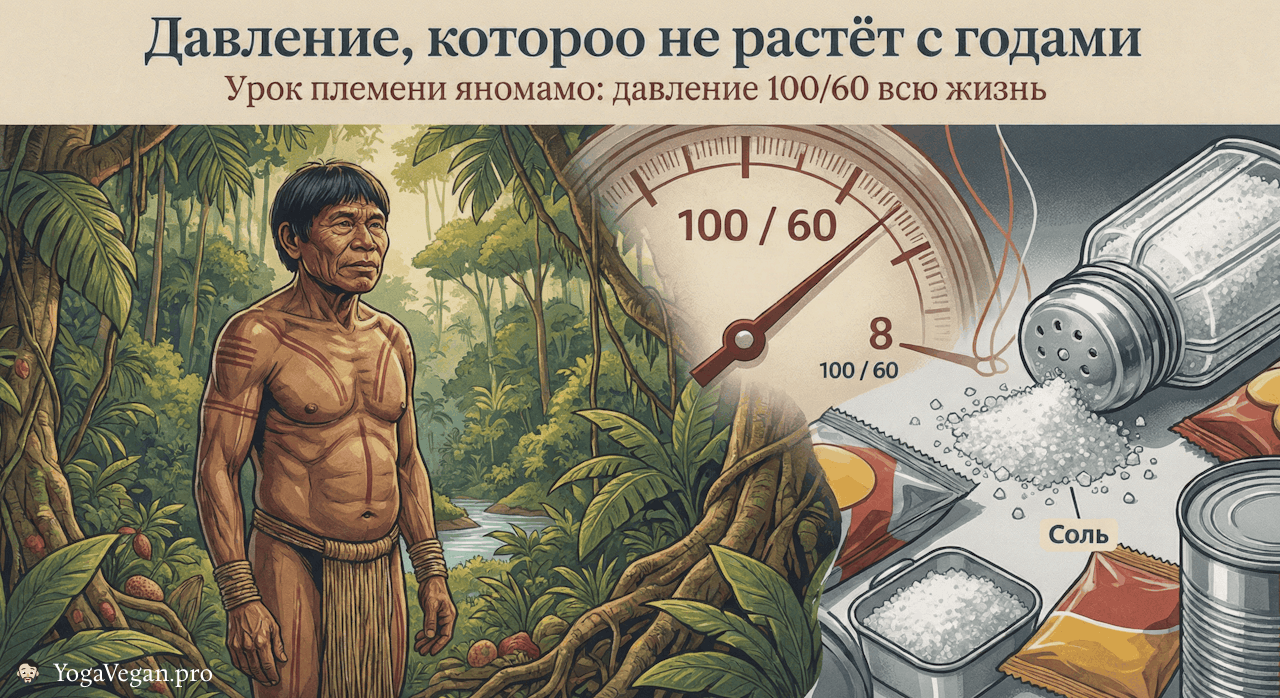
🩺 Pressure that does not rise with age - the lesson of the Yanomamo tribe with eternal pressure 100 over 60 and the salt connection
The Yanomamo are an indigenous people living in the Amazon jungle on the border of Brazil and Venezuela. Their blood pressure is 100 over 60. In adolescence. At forty and fifty years — 100 over 60. It simply does not rise.
For comparison: among other Brazilians of the same region, hypertension occurs in approximately 38% of the population. Among the Yanomamo — this percentage is 0.
Researchers who in the 1970s reached them through the jungle discovered something even stranger. The Yanomamo consume almost zero salt. Urine analysis showed that they excrete about 1 mmol of sodium per day. In the researchers themselves, who ate ordinary Western food, this figure was 152 mmol. The difference — 150 times.
🧂 Salt is not just a "taste additive." It is a factor that determines whether your pressure will crawl up every year or remain at the level of a twenty-year-old. The Yanomamo prove: one can live with pressure 100/60 at fifty years old. The question is what we eat or do not eat. The Yanomamo do not add salt to food at all. They get sodium only from natural products. This is not a "diet." This is their normal life for thousands of years.
What we call "normal" salt consumption in the West is an anomaly. Our ancestors over millions of years of evolution consumed many times less salt than we do today. The Yanomamo are not an exotic case. This is a living illustration of our biological norm.
There is data that after contact with civilization and the appearance of salt in the diet, pressure in such isolated groups begins to rise with age, like in all of us.
The harm of salt and its excess is well explained in the video: 🎬 Salt of the Earth - Michael Greger
🩺 Ideal pressure is 110/70 and below
The figure 120/80 is not an "ideal" but only a "norm," which we consider as such because of the widespread prevalence of hypertension. 110/70 is the point below which further reduction no longer gives additional benefit.
📊 What does this mean in practice?
Standard medical classifications (WHO) consider pressure below 120/80 optimal. But Greger cites data showing that in people on strictly plant-based nutrition, pressure averages about 110/65. And in "sedentary" vegans in one study — 104/62, which is better than in marathon runners eating a standard American diet.
🎯 What does pressure affect?
Pressure is the main risk factor for death in the world; about 9 million deaths are associated with it annually. It affects almost all key systems of the body:
- ❤️ Heart and vessels: High pressure is the main cause of atherosclerosis (clogging of arteries), heart attacks, and strokes. It forces the heart muscle to thicken and lose elasticity, which leads to heart failure.
- 🫘 Kidneys: Elevated pressure damages kidney vessels, which can lead to kidney failure.
- 🧠 Brain: In addition to stroke, it is associated with the risk of dementia and cognitive impairment.
💡 Why 110/70 and not 120/80?
Our ancestors throughout 90% of history consumed less than a quarter teaspoon of salt per day from food without adding it from outside. Tribes like the Yanomamo live with pressure 100/60 all their lives precisely because their diet is our biological norm.
Modern studies confirm: the risk of cardiovascular diseases grows linearly with each increase in pressure, starting already from figures above 115/75. That is, even "normal" 120/80 is already not optimal.
Source: 📚 "How Not to Die: Food in the Fight for Life" - Michael Greger