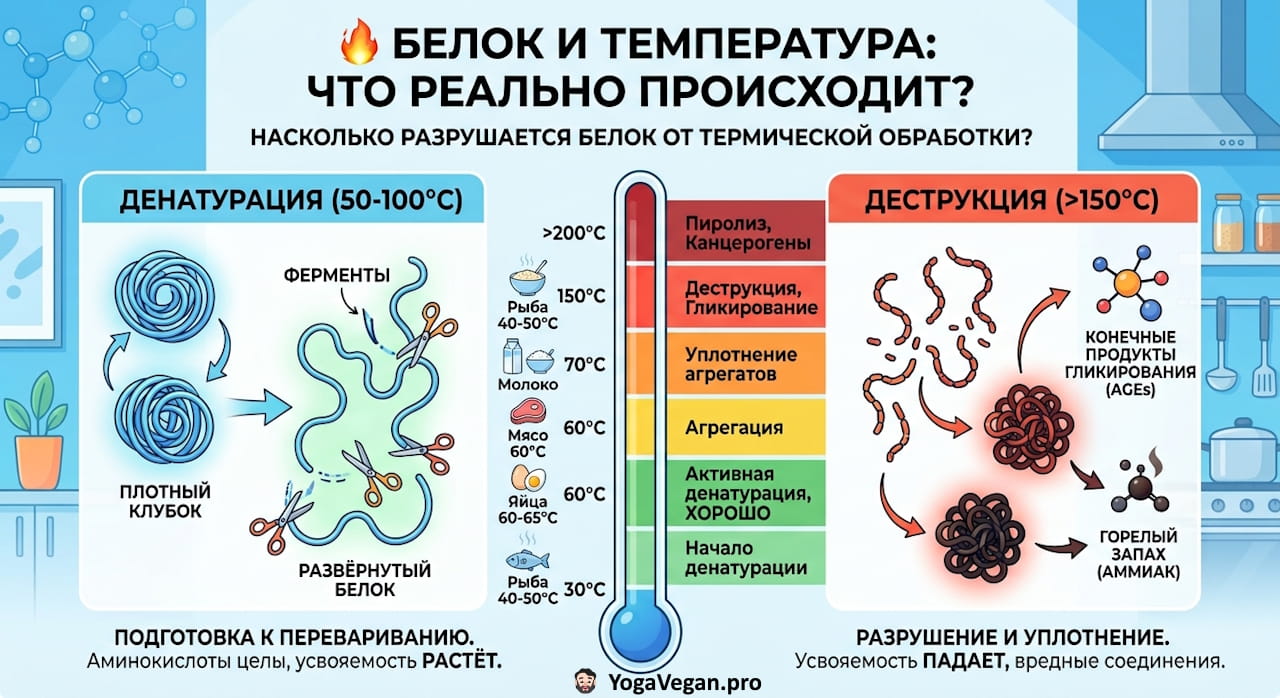
🔥 Protein destruction from heat treatment
Our body absorbs proteins after they are broken down into amino acids. There is an opinion that during heat treatment protein begins to lose its properties and is absorbed worse, as amino acids stick together, and the protein is destroyed, and during digestion it becomes impossible to absorb them. Is this so? The truth is more complex: everything depends on the type of protein, temperature, and time. Let's break it down.
There are two different processes. The first is denaturation: the protein unfolds, starting already at 40–50°C. This is not harm but normal preparation for digestion. The second is destruction: at high temperatures the protein enters into chemical reactions with sugars and fats, forming compounds that the body can no longer break down.
Denaturation — imagine protein as a tightly wound ball of thread. Amino acids are connected in a long chain that is folded into a complex three-dimensional structure. This structure is held by weak bonds — hydrogen, ionic, hydrophobic. When heated, these weak bonds break, and the ball unfolds. The amino acids remain intact, and due to the destruction of bonds between them, they are easier for our body to absorb.
Different proteins have different temperatures. Plant proteins begin denaturation at temperatures — from 60°C for peas to 82°C for rice. Egg white begins to coagulate at 60–65°C. Meat — at 60°C. Fish proteins — already at 40–50°C. Milk — at 70°C. That is why fish cooks faster than meat: its proteins denature earlier.
Unfolded protein is easier to digest. Digestive enzymes, like scissors, cut the chain into individual amino acids. To cut, they need to get to certain parts of the chain. In a folded ball these parts are hidden inside. In an unfolded one — they are open.
If you continue heating further, a completely different process begins. The unfolded protein chains begin to stick together into dense clumps — aggregates, and destruction begins.
Destruction — at temperatures above 150–180°C, amino acids begin to chemically break down. Some turn into D-forms that the body does not absorb. Others react with sugars (glycation). Others decompose to form ammonia, hydrogen sulfide, and other volatile compounds — hence the burnt smell.
Denaturation is reversible: if you remove the heat, some proteins can partially restore their structure.
Destruction is irreversible: destroyed amino acids can no longer be reassembled.
Denaturation does not reduce nutritional value. Destruction reduces it, sometimes to zero. Denaturation occurs at 60–80°C. Destruction begins at 150°C and above, and at 200°C+ it proceeds avalanche-like.
🌡 Temperature map
Up to 50°C — protein is stable, nothing happens. 50–60°C — denaturation begins, protein unfolds. 60–80°C — active denaturation. 80–100°C — denaturation complete, aggregation begins. 100–150°C — aggregates densify, some amino acids are lost. 150–200°C — destruction, glycation, formation of AGEs. Above 200°C — pyrolysis, formation of carcinogens, digestibility drops to 8–20%.
🥩 Animal protein: initially better absorbed
Meat, eggs, milk are absorbed at 90–96% in their original form. When heated above 70°C, muscle proteins begin to stick together into dense aggregates. It becomes harder for enzymes to penetrate inside. In one study, the digestibility of dry milk after heating at 120°C for 40 minutes fell from 85% to 73%. And when frying to 250°C, the digestibility of meat fell to 8–20%.
🫘 Plant protein: raw is absorbed worse
Most plant proteins without processing are absorbed at 35–72% because they contain digestive enzyme inhibitors. Boiling destroys these blockers and raises digestibility by 8–26%. Lentils, rice, chickpeas — all of this is unlocked precisely by heating. For fruits, protein digestibility from heating usually does not change much. At extreme temperatures above 180°C, plant protein irreversibly changes and loses functionality.
🍡 What happens to glucose and fat
Glucose enters into a glycation reaction with protein from 90 degrees — the very one that gives the golden crust, but up to 120° it is insignificant. The higher the temperature, the faster and deeper the reaction. Bound amino acids, especially lysine, become unavailable. Fats oxidize when heated, forming free radicals that attack proteins and vitamins starting from 110°.
When boiling and stewing, the temperature does not rise above 100°. Up to 100°C (boiling, stewing) — neither glycation nor fat oxidation practically occurs.
🫢 How to tell by food that protein is already "bad"
Light golden crust — normal, high digestibility. Dark brown — some amino acids are lost. Black and charred — digestibility tends to zero, plus carcinogens are formed. If the oil in the pan has turned black and smokes, and the product has become hard as a sole — the protein is destroyed. Burnt smell is a sign of decomposition of sulfur-containing amino acids.
🫕 Plant protein is better boiled and there is no point in frying
Boiling, stewing, steaming — these are the optimal methods for preparing plant protein. Frying plant protein is doubly harmful: it has more sugars than meat, so the glycation reaction starts faster and at a lower temperature. Lysine, which is already scarce in grains, is lost 1.5–2 times faster. If you fry tofu or a cutlet — only on minimal heat and until light browning, not until a hard crust.
🍎 About fruits and vegetables
There is negligible protein there — 0.5–2%. No need to bother. Enzymes are destroyed at 40–50°C, fiber softens at 60–80°C, but this does not affect your nutrition. The main thing lost when heating vegetables is vitamins, especially C and B group. They are destroyed at 60–90°C much faster than protein spoils. Therefore, it is better not to heat-treat them at all.
🍚 What is the slime that forms when cooking rice?
This slime is not dirt and not a harmful substance but dissolved starch that is washed out during cooking. And for the body it is more useful than harmful. Slime appears not only in rice but also in pearl barley, oatmeal.
When heated in water, the starch granules inside rice grains swell and break down — this process is called gelatinization. Part of the starch, mainly amylose and amylopectin, goes into the water and forms a colloidal solution. It is this that is perceived as "slime" or "paste."
🍲 This decoction is even useful
- Protects the mucous membrane of the stomach and intestines by coating it.
- Used for diarrhea: starch acts as a mild sorbent, retains water and slows peristalsis. WHO recommends rice decoction as a component of rehydration therapy.
- Contains water-soluble nutrients: B vitamins, potassium, magnesium, phosphorus.
This decoction is pure carbohydrate with a high glycemic index. For a healthy person this is not a problem, but with diabetes or insulin resistance it should be taken into account. Also in large quantities it can cause constipation.
📦 Practical conclusion
Boiling, stewing, steaming — this is a temperature of 80–100°C. Here denaturation occurs without destruction. Protein unfolds, becomes accessible to enzymes, digestibility is maximal. This is the optimal zone.
Frying at 150–200°C — destruction begins. Some amino acids are lost, AGEs are formed. Moderate golden crust is still acceptable but already with losses.
Grill and deep fry at 200°C+ — active destruction. Digestibility drops several times, carcinogens are formed. Black crust is no longer food but carbon.
📝 Summary
There is no need to fear denaturation — it is a normal stage of cooking. What should be feared is destruction — it begins where food turns black and smokes. The boundary between them is approximately 150°C. Everything below — works for you. Everything above — works against you.
Plant proteins should be boiled — this unlocks them. Animal proteins are better cooked gently — boiling, stewing, steaming. Frying to a black crust kills digestibility in both cases. And remember: moderate heat is not an enemy but a tool. The enemy is extreme temperature and time.
I also recommend reading: 🦍 Where can a vegan get protein?
📚 Sources
- Changes in anti-nutrients, protein solubility and digestibility in vegetable peas as affected by cooking. Food Chemistry, 2002.
- Physicochemical changes of fresh and pasteurised spinach juice during storage. University of Nottingham PhD thesis, 2024.
- Thermokinetic parameters of vitamin C and carotenoids in carrot: Prediction via 3D modelling. Europe PMC, 2026.
- Zahir M, Fogliano V, Capuano E. Effect of soybean processing on cell wall porosity and protein digestibility. Food & Function, 2020.
- Effect of household cooking on nutritional and anti-nutritional factors in green cowpea pods. Scilit, 2010.
- Stability of chlorophyll–protein complex in processed spinach: Effect of high hydrostatic pressure. Taylor & Francis, 2017.
- Zahir M, Fogliano V, Capuano E. Soybean germination limits cell wall integrity role and improves protein digestibility. Food Research International, 2021.
- Thermal Processing of Food: Potential Health Benefits and Risks. Wiley Online Library, 2007.