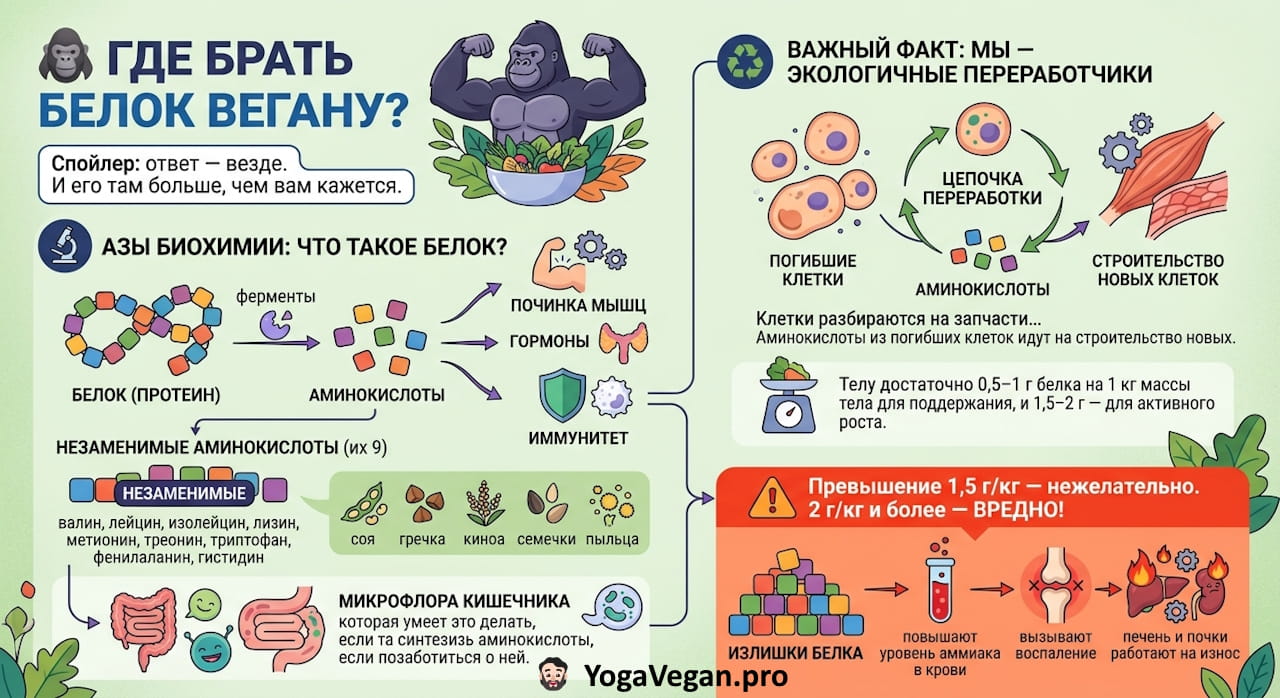
🦍 Where can a vegan get protein?
Spoiler: the answer is everywhere. And there is more of it there than you think.
This question haunts everyone who switches to plant-based nutrition. Let's sort out the physiology, the numbers, and the main marketing deception.
🔬 Basics of biochemistry: what is protein?
Protein is a long chain of "bricks" called amino acids. Once in the stomach, protein is broken down by enzymes into individual amino acids or short chains. Only after that does the body use them to repair muscles, hormones, and immunity.
Of the 20 standard amino acids, 9 are essential (valine, leucine, isoleucine, lysine, methionine, threonine, tryptophan, phenylalanine, and histidine). Our body cannot synthesize them itself — but this does not mean they are hard to find. They are in soy, buckwheat, quinoa, seeds, and even pollen. It also enlists the help of our intestinal microflora, which can do this if we take care of it.
🔄 Important fact: we are eco-friendly recyclers
The human body is a smart closed system. When cells age and break down (and this happens constantly), they are not thrown away but dismantled into parts. Amino acids from dead cells go into building new ones, so we do not need a huge influx of protein from outside.
That is why we do not need to eat kilograms of meat every day. The body needs 0.5–1 g of protein per 1 kg of body weight to maintain itself, and only 1.5–2 g for active athletic growth.
❗️ Exceeding 1.5 g/kg is undesirable. 2 g/kg and more is HARMFUL!
Excess protein raises ammonia levels in the blood, causes inflammation, and forces the liver and kidneys to work to exhaustion.
📊 What does the research say?
If we discard sports nutrition advertising and myths, it becomes obvious: worldwide the population has an excess of protein, not a deficiency. We eat 2–3 times more than the norm. This is well explained in a short video: Do vegetarians get enough protein - Michael Greger. More extensive information is in a wonderful book: "The China Study" - Colin Campbell
❓ Why are we constantly told "eat more protein"?
- Marketing. Protein bars, powders, and meat products are a multi-billion-dollar market.
- Outdated norms. Many recommendations were written for 1960s bodybuilders, not ordinary people.
- No one looks at tests. Without examination you are told: "You have low protein." But how did they determine this? By eye color? Also, test norms are shifted upward to match the current reality of consuming protein in huge quantities. In older studies from 1990, the urea norm was 1.2–2.5 mmol/L: link (3.4–7.0 mg/dL is 1.2–2.5 mmol/L). And now this norm has been shifted as far as 3.2–7.3 mmol/L. To match modern realities of protein consumption.
🧪 Personal example and parallel with iodine
I have a similar situation with iodine. I am fully on plant-based nutrition, do not take iodine-containing supplements, and do not eat seafood. However, my blood tests show a persistent excess of iodine: link to my tests
Where does so much iodine come from? The thing is that it is abundant everywhere and is even artificially added to salt. The question is why? Its excess is more dangerous than its deficiency. And also its compound with aluminum leads to a chemical reaction with combustion. Now in our cities there is a lot of aluminum in the dust, which enters our lungs, a chemical combustion reaction occurs that destroys the lungs and leads to pneumonia.
So why should I take it on faith that I lack protein, if without tests and without accounting for my microbiome this is just an empty phrase? Also, are test norms deliberately shifted upward to overstate protein in accordance with the current trend? For example, for breastfed infants the urea norm is 1.8–6.0 mmol/L, and there is no point in shifting the norms there since the child does not receive products from outside, but for adults in modern realities the norm is already considered 3.2–7.3 mmol/L, although earlier in 1990 the norm was 1.2–2.5 mmol/L, and mine is exactly 2.3 mmol/L. That is, according to the new norms, an adult organism that has already grown should increase protein concentration. Why? There is no active growth anymore. The concentration should on the contrary decrease, which is confirmed by the old norms. When we switch fully to plant-based nutrition, the body begins to shed this excess protein ballast, returning to normal.
🌱 Top plant sources of protein (per 100 g):
- Spirulina — 57 g
- Nutritional yeast (inactive) — 46 g
- Soybeans — 36 g
- Hemp seeds — 30 g
- Pumpkin seeds — 29 g
- Almonds — 22 g
- Flax seeds — 21 g
- Tempeh — 20 g
- Cashews — 18 g
- Quinoa — 14.5 g
- Oats — 13.5 g
- Green buckwheat — 13.3 g
- Legumes (cooked) — about 9 g
🔥 Life hacks for absorption
- Fermentation (tempeh, sauerkraut) — unlocks protein.
- Soaking — removes phytates (anti-nutrients).
- Sprouting — turns seeds into superfood.
🦍 About microflora and gorillas
Herbivorous gorillas have huge muscles, and they eat leaves and fruits. Where does the protein come from? It is produced by bacteria in the intestine from fiber and even nitrogen from the air! Humans have exactly the same mechanism, but it "sleeps" on a meat diet.
When you switch to plants, your microbiome rebuilds. Populate it with probiotics, add fiber — and your intestinal bacteria will begin to synthesize essential amino acids themselves (including tryptophan, lysine, glutamine).
⚠️ Important
Chew your food thoroughly! Gastric juice works better with crushed food. Do not suppress acidity with heavy combinations (e.g., meat+potatoes+bread).
📉 Deficiency or excess?
Proteins are not stored for future use. Everything you ate beyond the norm is excreted through the gastrointestinal tract or loads the kidneys.
Protein excess is more dangerous than deficiency! It causes:
- edema
- calcium loss (leached from bones)
- liver load
At the start of veganism, while the microflora has not adapted, a loss of strength is possible. But this is solved by cleansing the intestines, taking probiotics, and just 2–3 weeks of patience.
To increase the intake of amino acids into the body, one can resort to heat treatment: 🔥 Protein destruction from heat treatment
💬 Conclusion and question to you
Protein is everywhere. The only question is whether you trust your body or advertising banners.
- Why should you buy expensive protein if your old cells are already breaking down into amino acids right now?
- Why are you advised to eat more meat without blood tests, as in my case with iodine, where reality turned out to be the opposite?
👇 Share your experience in the comments! Have you taken amino acid tests? Did you listen to your body or blindly believe the norms that are constantly changing to match modern supply and demand?
This post is not a call to action but food for thought
📚 Sources
- Harm of protein excess. Delimaris I. (2013). "Adverse Effects Associated with Protein Intake above the Recommended Dietary Allowance for Adults" (ISRN Nutrition) → Confirms: high-protein diet → load on kidneys, liver, calcium leaching, risk of inflammation.
- Protein norms are overstated for most people. Stanford Medical School studies (data for 2020–2022) → 0.8 g/kg is enough for 98% of healthy people; increasing without exercise is pointless and potentially harmful.
- Microbiota synthesizes amino acids. Review of the Far Eastern State Medical University (2021). "Human microbiome: functions and role" → Microflora really does synthesize essential amino acids and vitamins, which explains the "gorilla" mechanism.
- Plant protein contains all 9 essential amino acids. Conference materials "Youth in solving current problems of science" (Kyrgyzstan, 2022) → Soy, quinoa, spirulina, hemp — complete sources. Digestibility is lower than animal (62–80%), but is compensated by diversity and fermentation.