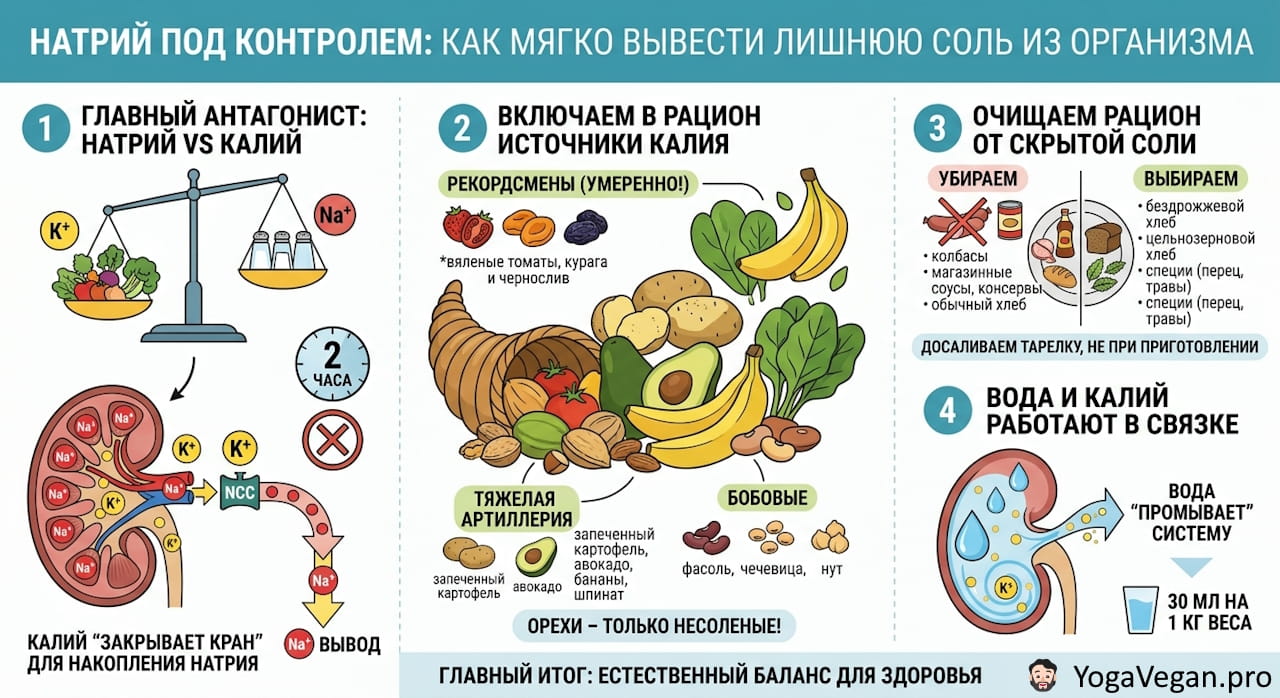
🧂 Sodium under control: remove excess salt
The modern diet is overloaded with sodium: hidden salt is in bread, sauces, sausages, and canned goods. Its excess leads to fluid retention, edema, and increased pressure. More details about the excess of sodium salt in the body in this post with video: "Salt of the Earth" - Michael Greger. Fortunately, nature has an "antidote" — potassium and other ways to remove sodium salt from the body.
🧭 Main ways to reduce sodium
⚖️ 1. The main antagonist: sodium vs potassium
The key method of reducing sodium levels is to increase potassium intake. This works like ideal scales: the body strives for electrolyte balance.
How does this work at the physiological level? When we eat potassium-containing food, the potassium level in the blood rises. In response, in the renal tubules a special protein (NCC) is inactivated, which is responsible for returning sodium to the blood. Simply put, potassium "closes the tap" for the reabsorption of sodium, and it is actively excreted in the urine.
Moreover, the effect comes quickly — literally within 2 hours after taking potassium. That is why a diet rich in potassium is the first recommendation of cardiologists for gently lowering pressure without diuretic pills.
🍌 2. Include sources of potassium in the diet
To help the body get rid of excess sodium, we focus on plant food. The most powerful sources of potassium:
- Record holders in concentration: dried porcini mushrooms (≈ 3900 mg/100 g), sun-dried tomatoes, dried apricots, and prunes. But be careful: they are very caloric and sweet, for daily intake the options below are better.
- Heavy artillery: baked potatoes in their skins (about 500–900 mg per large tuber), avocado, bananas, spinach, and chard.
- Legumes: beans, lentils, and chickpeas (contain 600–1100 mg per 100 g of dry product).
Important nuance: if you take nuts or seeds as a source of potassium, be sure to choose unsalted ones. Otherwise you will eat potassium along with a new portion of sodium, and there will be no effect.
🧼 3. Cleanse the diet of hidden salt
While potassium works on removal, we must block the influx of new sodium. The main steps:
- Remove semi-finished products: sausages, frankfurters, ready-made cutlets, and store-bought sauces (ketchup, mayonnaise, soy sauce) — these are champions in salt content.
- Look at bread if we cannot exclude it: 100 grams of ordinary white bread can contain up to 500 mg of sodium. Switch to yeast-free or whole-grain with reduced soda/salt content if you cannot exclude bread at all.
- Salt the plate if there is no way without salt: cook without salt, and add a little salt already to the finished dish at the table. This way you will feel the taste of salt more vividly and use it many times less.
💧 4. Water and potassium work in tandem
For the kidneys to actively filter and remove sodium, they need water. In the absence of contraindications (heart or kidney problems), try to drink pure water in the volume of 30 ml per 1 kg of your weight.
If you drink little, the body will save fluid, and sodium will not be able to fully leave through the kidneys — it will accumulate in the intercellular space, creating edema. A sufficient drinking regime enhances the action of potassium, helping to "wash" the system faster.
✅ The main result: reducing sodium without strict diets is realistic. Add more vegetables or fruits rich in potassium to the daily menu (for example, a salad with spinach and avocado or a banana for a snack), remove processed meat (fish, poultry too) and drink water. In just a couple of days you will notice that the edema goes away and well-being improves.