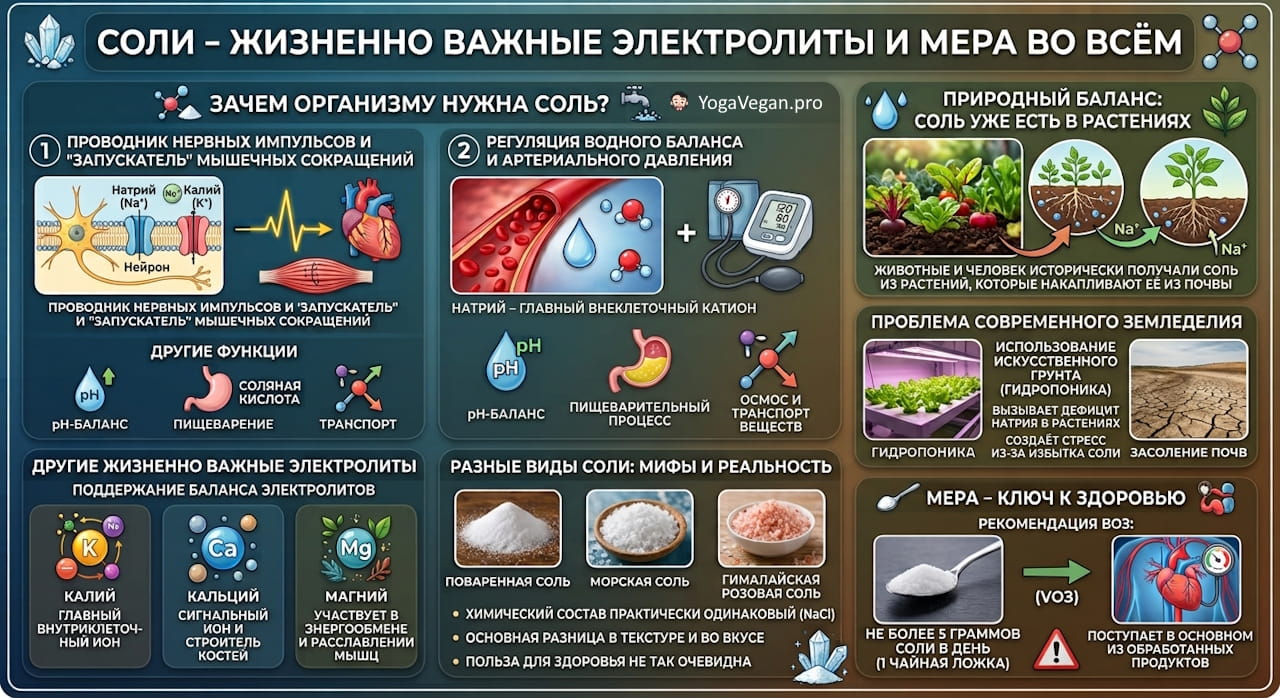
🧂 Salts - vital electrolytes and moderation
Salt is one of the most ancient and controversial seasonings in human history. We are used to hearing that it is harmful, but our body cannot exist without it. In this article we will figure out why salt is necessary for life, what role it plays in the body, what types of salt there are, and where the line between benefit and harm passes. And we will also discuss where we get salt from food and why everything in nature is arranged harmoniously.
⚗️ The chemistry of the process: salt as an electrolyte
From the point of view of chemistry, table salt is sodium chloride (NaCl), consisting of approximately 40% sodium and 60% chlorides. It is the ions of sodium (Na⁺) and chlorine (Cl⁻) that make salt the most important electrolyte. Electrolytes are substances that in solution break down into charged particles and are capable of conducting electric current. In our body this ability is crucial.
🧠 Why does the body need salt?
- Conductor of nerve impulses and "trigger" of muscle contractions. The key role of salt in the body is connected with the conduction of nerve impulses. This process directly depends on the movement of sodium and potassium ions through the membrane of nerve cells. At rest, inside the nerve cell there is more potassium ions, and outside — sodium. When a signal comes, the cell membrane becomes permeable to sodium, and the flow of Na⁺ ions inward creates an electrical potential — a nerve impulse that runs along the nerve fibers. This mechanism was confirmed by classical studies on frog nerve fibers, which showed that without sodium ions the conduction of impulses is impossible, and its restoration occurs within a few minutes after adding sodium. Later scientific reviews confirm: the concentration gradient of sodium between extracellular and intracellular fluid ensures the excitability of nerve and muscle cells. It is thanks to this mechanism that the brain can send signals to the muscles, forcing them to contract. This applies to both skeletal muscles and the heart muscle.
- Regulation of water balance and blood pressure. Sodium is the main cation (positively charged ion) of extracellular fluid. Its osmotic action helps retain water in the bloodstream and intercellular space, ensuring a stable volume of circulating blood. This mechanism is directly connected with the regulation of blood pressure.
- Other important functions. In addition, salt is necessary for maintaining the acid-base balance (pH) of the blood, the formation of gastric juice (chloride ions are a component of hydrochloric acid necessary for digestion), and the transport of nutrients (sodium participates in the mechanisms of transfer of glucose and amino acids through cell membranes).
⚙️ Other vital electrolytes: potassium, calcium, magnesium
Although the headlines most often mention salt (sodium chloride), a whole "ensemble" of electrolytes is necessary for the normal functioning of the body. Potassium, calcium, and magnesium work in close interconnection with sodium, and their balance is critical for health.
- Potassium — the main intracellular ion. Potassium (K⁺) is the main positive ion inside cells. It plays a key role in the conduction of nerve impulses and muscle contraction, especially the heart muscle (together with sodium it forms the "electrical" potential of cell membranes), regulation of heart rhythm (sufficient potassium intake is associated with a reduced risk of hypertension and stroke), and maintenance of normal blood pressure, counteracting the effects of sodium. Important: the modern diet is often poor in potassium, especially compared to the "natural diet" of our ancestors, which increases the risks for the cardiovascular system.
- Calcium — the builder of bones and a signaling ion. Calcium (Ca²⁺) is not only material for bones and teeth but also the most important electrolyte. It participates in muscle contractions (launches the process of contraction of muscle fibers), transmission of nerve impulses and hormone secretion, blood clotting (a necessary component of the cascade of reactions), as well as in the regulation of heart rhythm and vascular tone. About 98% of calcium in the body is stored in the bones, which serve as its "depot." With chronic deficiency or excess, not only bones suffer but also neuromuscular regulation.
- Magnesium — the "antipode" of calcium and an energy coenzyme. Magnesium (Mg²⁺) is the fourth most common mineral in the body, participating in hundreds of biochemical reactions. It is necessary for energy production (magnesium is needed to activate ATP — the main energy molecule of the cell), muscle relaxation (acts as a physiological antagonist of calcium, promoting muscle relaxation and preventing spasms and cramps), the work of the nervous system and the health of the cardiovascular system, as well as for maintaining the balance of potassium and sodium (magnesium is a cofactor of Na⁺/K⁺-ATPase — the "pump" that maintains the gradient of these ions). Magnesium deficiency (hypomagnesemia) is often associated with muscle cramps, heart rhythm disturbances, and increased fatigue.
- The interconnection of electrolytes — a delicate balance. It is important to understand that electrolytes do not act in isolation. Their balance is a finely tuned system. For example, an excess of sodium in the modern diet is often combined with a deficiency of potassium, calcium, and magnesium, which creates prerequisites for hypertension and other diseases. Potassium and magnesium work as antagonists of sodium and calcium in the regulation of muscle tone. Therefore, in nutrition it is important not just to limit salt but also to ensure the intake of all these minerals, especially from natural products.
🌱 Natural balance: salts are already in plants
It is important to understand that our body historically received the necessary salts not from the salt shaker but from food. Plants are a natural source of sodium. In nature, under natural conditions, plants growing on rich, life-giving soils accumulate in their tissues a certain amount of various salts (potassium, sodium, magnesium, calcium), which is quite enough to cover the needs of herbivorous animals, and through them — of humans.
According to studies, sodium is a useful, although not absolutely indispensable, element for plants. It stimulates their growth, participates in osmotic regulation, and helps plants cope with drought. Nature created a perfect system: plants growing on healthy soil contain microelements, including sodium and other salts, in a balanced amount.
🚜 The problem of modern agriculture
However, under conditions of modern intensive agriculture this natural balance is disrupted. Two contradictory practices are actively used, which lead to the depletion of plants with salts.
- The use of artificial soil (hydroponics) and chemical fertilizers. In hydroponic systems and when using synthetic fertilizers, the emphasis is often on the main macronutrients (nitrogen, phosphorus, potassium), and the content of other salts (calcium, magnesium, sodium) in the nutrient solution may be unintentionally low. Studies show that the content of these salts in cultivated plants grown with the use of agrochemicals can be significantly lower than in wild vegetation, where it reaches natural values. This is explained by the fact that tap water with low salt content is often used for irrigation, unlike rainwater or water from natural sources.
- Soil salinization. On the other hand, in arid regions and in places with poor drainage, the opposite problem arises — soil salinization. An excess of salts, especially sodium chloride, is toxic to plants and inhibits their growth. To survive on such soils, plants are forced to accumulate salt in the roots and limit its entry into leaves and fruits to avoid death. As a result, vegetables grown on such soils can accumulate salt, but their growth and yield are significantly reduced.
Thus, modern agriculture, striving for high yields, often creates conditions in which plants either do not receive enough salts or experience stress from their excess (on saline soils). In both cases, vegetables and fruits lose their natural ability to be a balanced source of necessary microelements. That is why, despite the fact that salts are already present in nature in plants, modern humans are increasingly forced to resort to additional salting of food with ordinary salt, with harm to the salt balance due to an excess of sodium salt.
🏔️ Different types of salt: myths and reality
On store shelves you can find many types of salt: sea, Himalayan, rock, table, iodized. The main thing to know: from a chemical point of view, all of them are predominantly sodium chloride.
- Table salt: usually highly refined, contains almost 100% NaCl, often with added iodine (for the prevention of iodine deficiency, which leads to an excess of iodine in the body) and anti-caking agents.
- Sea salt: obtained by evaporating seawater. May contain trace amounts of magnesium, calcium, potassium, and other microelements. However, their concentration is so small that it does not have a significant effect on health.
- Himalayan salt: mined in salt mines, contains impurities of iron oxide, giving it a pink color. Despite marketing claims, its composition in the main component does not differ from other types of salt.
As experts rightly note, the main difference between these types of salt is texture and taste, not health benefits. The choice between them is more a matter of culinary preferences.
⚖️ Moderation is the key to health
The body needs salt, but in very limited quantities. Clinical sodium deficiency in healthy people is rare and is usually associated with severe fluid loss (profuse sweating, vomiting, diarrhea) or certain diseases.
The main danger comes from an excess of salt. The World Health Organization (WHO) and other authoritative organizations recommend consuming no more than 5 grams of salt (2 grams of sodium) per day. This is about one teaspoon.
The problem is that most of the salt enters our body not from the salt shaker but from processed products: bread, cheese, sausages, sauces, canned goods. Excessive sodium intake is associated with an increased risk of developing arterial hypertension (high blood pressure), cardiovascular diseases and stroke, kidney diseases, osteoporosis, and kidney stones.
The excess of sodium salt is well described in the video: "Salt of the Earth" - Michael Greger
📝 Conclusion
Salt is a vital element performing key functions in the body. It is an electrolyte that ensures the conduction of nerve impulses and muscle contraction, maintains water balance and blood pressure. However, sodium works in close connection with other electrolytes — potassium, calcium, and magnesium, each of which performs a unique role in neuromuscular regulation, energy metabolism, and bone health. The modern diet often disrupts this natural balance, giving an excess of sodium and a deficiency of potassium, calcium, and magnesium.
In an ideal natural system, a person would receive the necessary amount of all these minerals in the right proportions from plants, which accumulate them from healthy soil in the right amounts. However, methods of modern industrial agriculture — hydroponics and excessive use of chemicals — disrupt this balance, making products either poor in sodium or forcing plants to accumulate it under stressful conditions. Different types of salt (sea, Himalayan, table) are practically identical in their nutritional value. The main principle for maintaining health is balance and conscious limitation of sodium salt consumption, especially from processed products. Remember: moderation is needed in everything.
How to remove excess salt is described in the article: Sodium under control: remove excess salt
List of literature (scientific reviews and recommendations)
- Strazzullo, P., et al. (2025). Sodium. Advances in Nutrition, 16(5), 100409.
- Strazzullo, P., et al. (2025). Sodium. PubMed
- Lorente de Nó, R. (1951). Equilibria of frog nerve with different external concentrations of sodium ions. The Journal of General Physiology, 35(1), 145–182.
- Hodgkin, A. L. (1951). The ionic basis of electrical activity in nerve and muscle. Biological Reviews, 26, 339-409.
- Subbarao, G.V., et al. (2001). Sodium: A Functional Nutrient in Plants. Handbook of Plant Nutrition.
- Zhang, J., et al. (2024). High-resolution community-level sodium variation on the Tibetan Plateau. Science of The Total Environment, 944, 173766.
- Active accumulation of sodium by the roots of aquatic plants. (1973). New Phytologist.
- Comparative content of alkali elements in plants. Armenian Agrochemical Journal.
- Kuramshina, Z.M., et al. (2023). The effect of salt on the content of potassium and sodium in plant shoots. Plant Physiology, 70(3), 293-300.
- Maathuis, F.J.M. (2014). Sodium in plants: perception, signalling, and regulation of sodium fluxes. Journal of Experimental Botany, 65(3), 849-858.
- World Health Organization (WHO) recommendations on sodium intake.
- European Food Safety Authority (EFSA) recommendations on sodium intake.
- Burton, R.F. (1983). Inorganic ion pairs in physiology: significance and quantitation. PubMed.
- Karpanen, H., et al. Sodium, potassium, calcium, and magnesium changes in food items and diets. Journal of Human Hypertension.
- Venes, Donald, editor. "Electrolyte." Taber's Medical Dictionary, 24th ed., F.A. Davis Company, 2021.