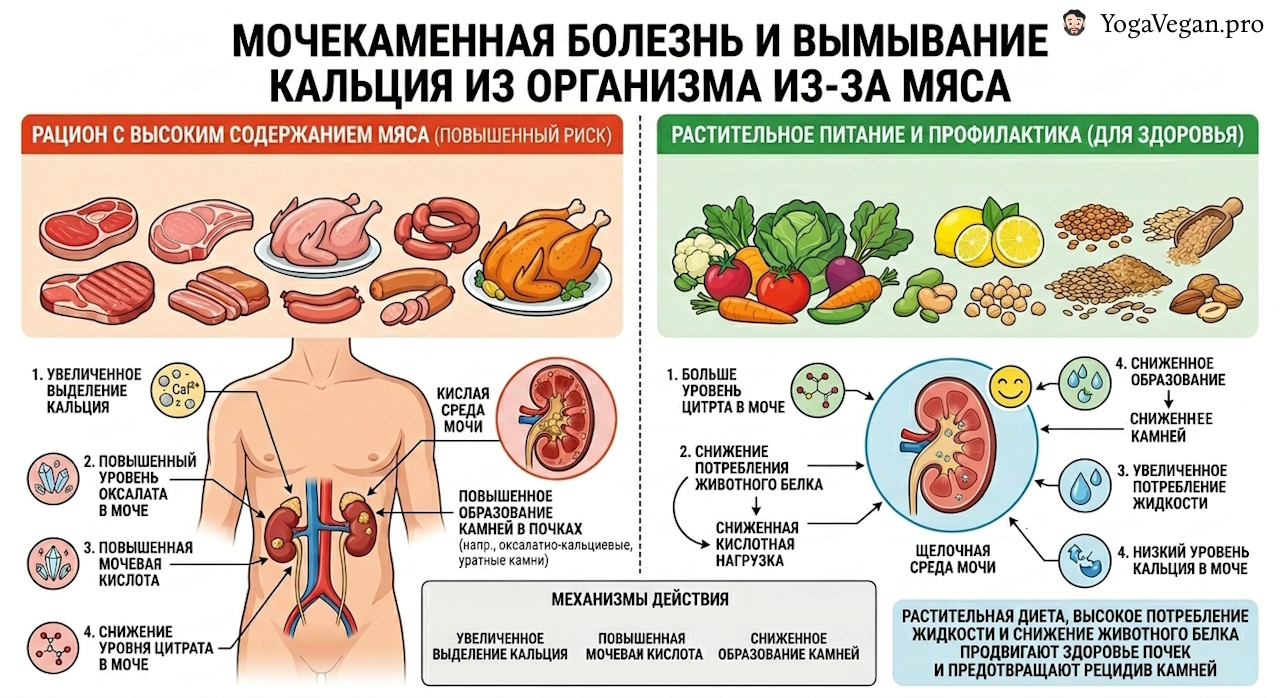
🪨 Urolithiasis and leaching of calcium from the body due to meat
Greger in his works (books and on the website NutritionFacts.org) considers animal protein as a key risk factor for urolithiasis. His conclusions are based on intervention studies, and he states directly: reducing animal protein is more effective for the prevention and treatment of stones than limiting calcium or oxalates.
🐟 On a standard diet you are already at risk
Greger refers to a British intervention study where participants simply added one can of tuna per day to their diet. Result: the probability of stone formation on those days increased by 250%. According to him, this amount of fish merely brought protein intake to the level of the average American.
He emphasizes that already in the late 1970s it was known: the only dietary factor consistently associated with stones is animal protein. Moreover, it is not about protein in general but specifically animal protein: the higher its consumption, the higher the chance not just of getting one stone but of getting multiple episodes.
💡 Mechanism: acid, uric acid, and stone "seeds"
Greger explains the harm of animal protein through acid load. Animal protein is rich in sulfur-containing amino acids, which acidify the body during metabolism. This leads to two consequences:
- Calcium leaching: To neutralize the acid, the body is forced to pull calcium from the bones, and it is excreted in the urine.
- Decrease in urine pH: Acidified urine (pH about 5.95 on a standard Western diet) creates an ideal environment for crystallization.
In addition, purines from meat raise uric acid levels. Its crystals, according to Greger, can work as a "seed" for the formation of calcium stones or form their own urate stones (the second most common).
🧪 Acid load and calcium leaching
Animal protein is a source of "acid ash." Its processing by the body creates a high acid load. To neutralize this acid, the body is forced to pull calcium from the bones. This calcium is then excreted in the urine, which leads to a state of hypercalciuria (increased calcium content in the urine). It is calcium in the urine that is one of the main "building materials" for most stones.
🚫 Decrease in citrate — the natural defender
Citrate is a substance that is normally present in the urine and prevents crystallization of calcium and oxalates (that is, it works as a natural "antifreeze" against stones). The acid load from animal protein suppresses the production and excretion of citrate, which leads to hypocitraturia (low citrate level in the urine). Without this protection, the risk of crystals sticking together and stone growth sharply increases.
🩸 Increase in uric acid levels
Red meat and offal are rich in purines. When they are broken down, uric acid is formed. A high level of uric acid in the urine (hyperuricosuria) creates two risks:
- It can form its own stones (urate).
- Uric acid crystals can serve as a "seed" (nucleus) for the further growth of calcium oxalate crystals.
📉 The LAKE system: fish is the leader in acid
Greger cites the LAKE (Load of Acid to Kidney) system — an assessment of acid load on the kidneys taking into account typical portions. According to these data, fish (especially tuna) is the most acid-forming product, followed by pork, poultry, cheese, beef. Eggs are more acidic than beef, but people eat them in smaller portions.
An important nuance: gram for gram, fish may be even "worse" than meat in its effect on uric acid, although the overall picture is more complex. Greger's conclusion: it is necessary to limit all types of animal protein, not just red meat, and to do so substantially, not "a little bit."
🥗 What happens when you give up meat
Greger cites data that removing all meat products from the standard Western diet reduces the risk of uric acid crystallization by 93% in just a few days. Urine pH rises from acidic 5.95 to the target 6.8.
He also refers to a 2014 study where vegetarians were less often hospitalized with kidney stones compared to meat eaters. Among meat eaters, an increase in meat consumption was associated with an increased risk.
⚖️ Criticism of the approach
Animal protein (including fish) is the main dietary enemy for the kidneys. Limiting calcium or oxalates is secondary. To really reduce the risk, it is necessary to significantly reduce the consumption of all types of animal protein and alkalize the urine with plant food.
Source: 📚 "How Not to Die: Food in the Fight for Life" - Michael Greger