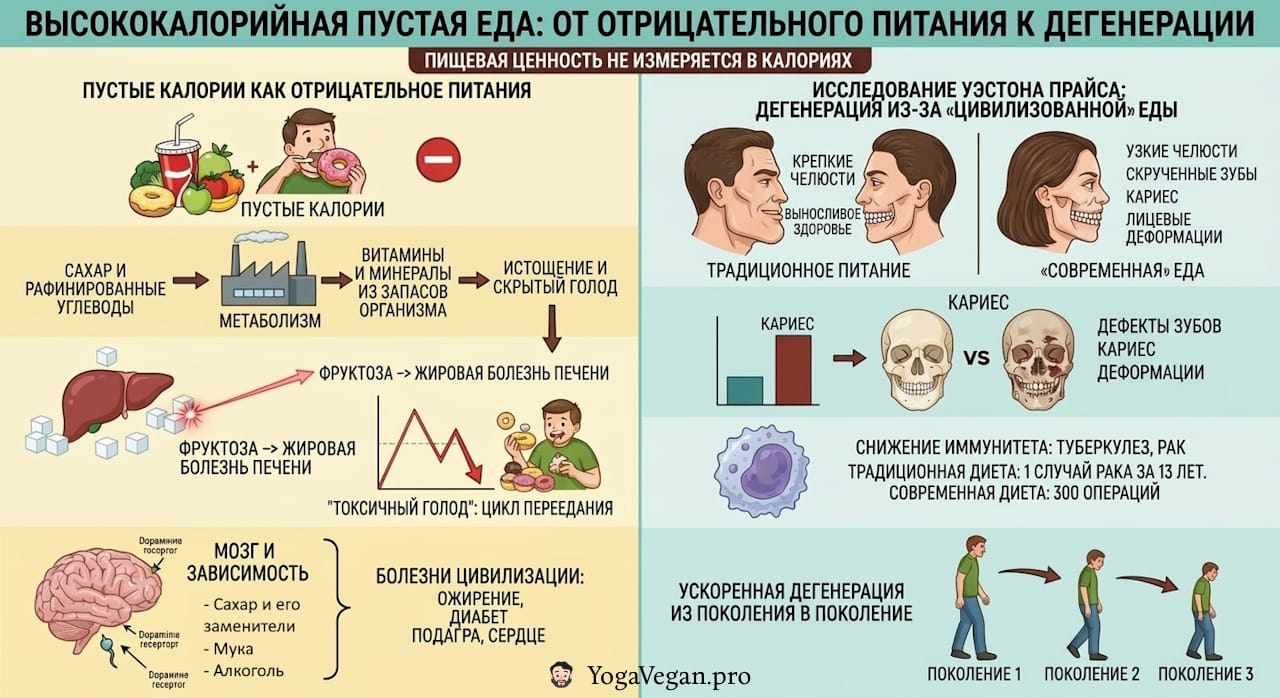
🍰 High-calorie empty food harms health
The problem with high-calorie but nutrient-poor food is that it displaces products rich in macro- and micronutrients from the diet. These are not just "empty calories" but, in the words of Dr. Michael Greger, "negative nutrition."
When the diet is filled with high-calorie but "empty" products (sugar, white flour, oils), they physically displace products rich in proteins, healthy fats, vitamins, and minerals. The body receives "fuel" (calories) but does not receive "building materials" (nutrients) to maintain bones, teeth, the immune system, and metabolism, and the resource for processing products is limited, just as the resource for processing minerals at a deposit is limited. If the raw material is empty, the conveyor will use up its performance resource but still will not be able to obtain minerals, and further, even if there is ore with minerals, the plant's resources simply will not be enough to extract them.
🍩 "Empty calories" as negative nutrition
Michael Greger, citing warnings from the American Medical Association, explains this mechanism. Sugar and refined carbohydrates not only bring no nutritional value but also require expenditure of vitamins and minerals from the body's reserves for their metabolism.
In other words, the more you eat products with "empty calories," the more the reserves of useful nutrients are depleted. This creates a paradoxical situation: a person may consume an excess of calories while suffering from hidden hunger at the cellular level.
Modern "empty" products (especially sugar and all its varieties) trigger processes that directly lead to chronic diseases. Here are several concrete examples from his argumentation:
- Metabolic shift: fructose and fatty liver disease. Greger compares the metabolism of fructose with the metabolism of alcohol. Fructose added to sweet drinks and processed products "is aimed like a laser beam at the liver," contributing to fat accumulation. This has led to an outbreak of non-alcoholic fatty liver disease, which has become a public health problem over the past three decades. "Empty calories" are not just an absence of benefit; they are a direct blow to a key detoxification organ.
- "Toxic hunger": the binge cycle. Greger describes a mechanism he calls "toxic hunger." An hour after consuming sugar, blood glucose levels fall below normal (hypoglycemia), which causes a strong feeling of hunger and makes the person reach again for fast carbohydrates. This is not just a "craving for sweets" but a physiological trap leading to obesity.
- Brain and addiction. Citing PET scan data, Greger says that overeating sugar causes changes in the brain parallel to those observed in drug addiction. In people with obesity, the sensitivity of dopamine receptors (the reward system) decreases, which is why they need more and more food to get the same pleasure. He draws a direct parallel with cocaine and alcohol.
- The list of "civilization" diseases. According to Greger, consumption of sugar and "empty" calories raises uric acid levels, which is associated with gout, hypertension, obesity, prediabetes, diabetes, kidney and heart diseases. This creates constant inflammation, which is the soil for 75% of deaths in the world (cardiovascular, cancer, dementia).
🦷 Weston Price's research: degeneration due to "civilized" food
Greger's conclusions echo the observations of Dr. Weston Price, which he described in the book 📚 "Nutrition and Physical Degeneration" almost a hundred years ago.
Price traveled the world and compared the health of isolated populations eating traditionally and those who switched to "modern" food (white flour, white sugar, refined oils, canned goods). The results were dramatic.
In people who switched to a diet of "empty" products, the following rapidly developed:
- Caries and jaw deformations: In traditional peoples, teeth were straight and jaws were wide, with minimal caries. After switching to "civilized" food, their children developed crooked teeth, narrow jaws, and mass caries.
- Decline in immunity: Price noted a sharp drop in resistance to diseases such as tuberculosis, cancer, degeneration of the body and mental abilities. Price, being a dentist, recorded degeneration "in the field," comparing isolated populations. His examples are strong in their visual clarity — photographs of skulls, jaws, and mortality statistics.
- Physical deformations of the skull and teeth. This is the most vivid and documented example. Price found that indigenous peoples eating traditionally had "ideal dental arches, minimal caries." After switching to "civilized" food (white flour, sugar, canned goods), already in the first generation they developed deformed jaws, crooked teeth, narrow nasal passages, and crowded teeth. "Empty calories" displace the nutrients necessary for the formation of bone tissue and lead to deformities.
- Outbreaks of tuberculosis and decline in immunity. Price noted that after contact with "modern" food, isolated peoples sharply dropped their resistance to tuberculosis. The most dramatic example is the population of the island of Bardsey (Scotland). After processed products entered their diet, resistance to tuberculosis "quickly disappeared, leading to the almost complete extinction of the islanders." This shows that the displacement of nutrients undermines not only bones but also the immune system as a whole.
- Cancer statistics among aborigines. Price cited reports of doctors working with the indigenous population of Australia. Doctors noted that over 13 years, among aborigines eating traditionally, only 1 case of cancer was recorded, and even that with a benign tumor. At the same time, among residents of the same region who switched to modern food, over the same period 300 operations to remove tumors were performed. This is a strong argument in favor of "nutrient density" versus "empty calories."
- Accelerated degeneration from generation to generation. Price emphasized that degeneration after switching to the Western diet was rapid and manifested already in the first generation, and only worsened with each subsequent generation. This is an important thesis: "empty calories" are not slow wear but a rapid loss of the quality of "human material."
🧠 Why this happens: "nutrient exchange"
Both lines of reasoning — the modern one of Greger and the historical one of Price — point to one fundamental problem: nutritional value is not measured in calories.
Thus, high-calorie food with empty calories is not just "useless" food. It actively contributes to degeneration by forcing the body to spend its own resources to process sugar, refined carbohydrates, and empty calories.
Source: 📚 "How Not to Die: Food in the Fight for Life" - Michael Greger and 📚 "Nutrition and Physical Degeneration" - Weston Price