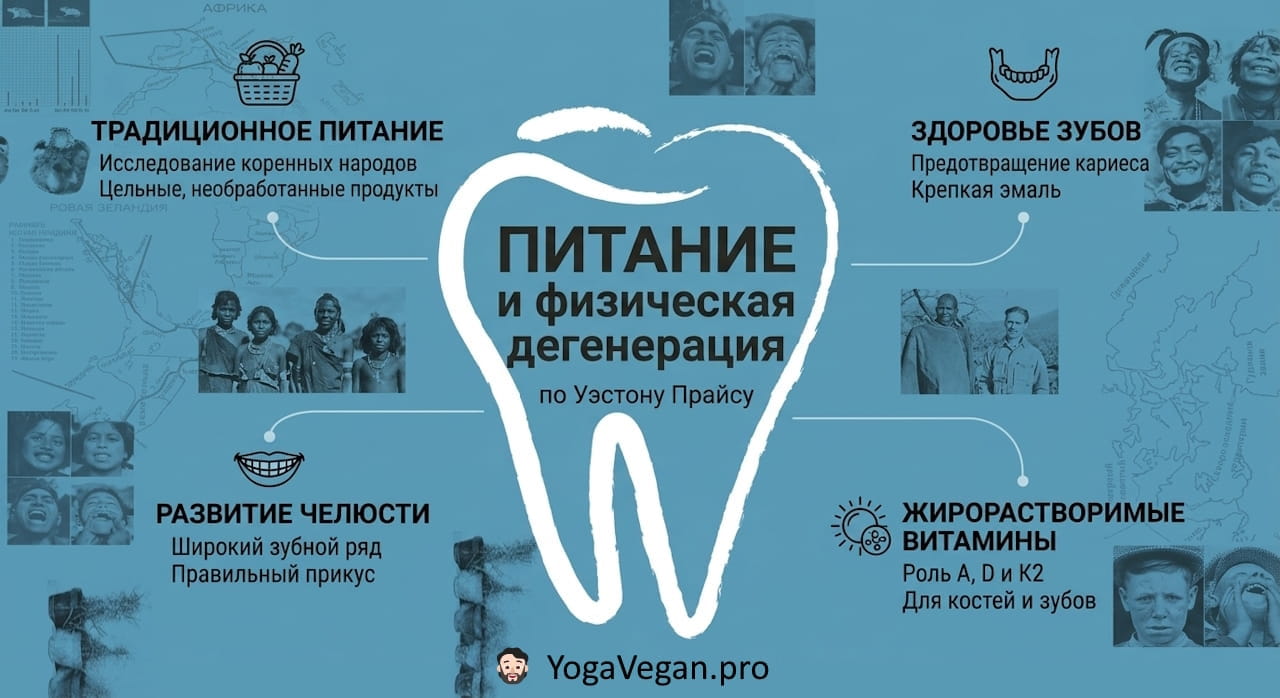
📚 "Nutrition and Physical Degeneration" - Weston Price
Weston Price (1870–1948) was an American dentist from Cleveland who began his research after noticing that his patients had more and more caries, crooked teeth, and narrow jaws every year. His key insight: instead of studying what sick people do wrong, he decided to find those whose teeth were perfect and understand what they do right. This led him to the idea that the cause of tooth destruction is not poor hygiene but incomplete nutrition.
Price made his travels in the 1930s, spending more than ten years on it. He traveled the world studying isolated groups of people not yet touched by Western civilization: inhabitants of the Swiss Lötschental valley, Gaelic communities of the Outer Hebrides, Eskimos and Indians of North America, tribes of Africa, aborigines of Australia, Maori of New Zealand, Polynesians, and Indians of South America.
💀 Skulls without damaged teeth
Studying ancient burials, Price found striking evidence. Among 1,276 skulls of ancient Peruvian Indians he found not a single deformation of the dental arch. For comparison: among modern Americans whom he studied, up to 75% had deformations of jaws and dental arches. This meant that narrowed jaws and crooked teeth are not a genetic inevitability but a consequence of changed nutrition.
🦷 How civilization destroyed teeth in a year
Price observed dramatic contrasts within the same peoples. In people eating traditionally, teeth were strong and straight. But as soon as they switched to "civilized" food — white flour, sugar, canned goods, refined oils — literally within one year mass caries began. The example of young people from the Lötschental valley was especially indicative: caries appeared in them only when they left the valley and began to eat modern food. When they returned to traditional nutrition, tooth destruction stopped by itself, without fillings.
Earlier they took saliva for analysis to understand which elements are missing and because of what caries occurs. The content of microelements in saliva strongly affects the health of teeth.
🫕 Changes in the body on modern nutrition
Price himself wrote that degeneration begins "even in the first generation after parents switch to refined food", their offspring became literally shorter, and also there was general narrowing and underdevelopment of the skeleton and it "rapidly intensifies" in subsequent generations. The cumulative effect on the skeleton was obvious already immediately. On the photographs in the book this is especially noticeable: in the older children in the family (born before the switch to modern food) faces are wide, cheekbones developed, teeth stand straight. In the younger (born after) — faces are elongated, narrow, teeth crowded and grow unevenly, jaws underdeveloped. As in many people in modern society even now this is considered the norm.
Studying ancient burials, he found that in the indigenous peoples of Peru and Florida the average height was about 6 feet (approximately 183 cm), while they had ideal dental arches and almost complete absence of caries, also in his wanderings he found tribes reaching a height of 230 cm.
In his contemporary Americans whom he studied, up to 75% had deformations of jaws and dental arches, and teeth ever subject to caries more than 80%. In tribes on traditional nutrition caries was for the most part in less than 0.5% of teeth, except for tribes that ate gluten-containing products, where caries was in more than 6% of teeth.
🌾 How wheat, rye, and barley affect health (gluten)
Studying the tribe of Arab farmers in North Africa (region of Sudan and Egypt) who grew and ate wheat, rye, and barley — that is, grains containing gluten, he encountered a contradiction in his own logic about "traditional nutrition." Price expected that any traditional nutrition would protect against caries. But in farmers who ate grain, the picture turned out different:
- Caries was significantly more common than in neighboring tribes who ate mainly animal food (Nuer, Dinka, Maasai), namely 12 times: 6% instead of 0.5%.
- Dental arches were narrower, jaws less developed than in pastoralists and hunters.
- Physical development was worse than in neighboring Nuer — they were not as tall and strong.
Price did not blame gluten directly — such a concept did not yet exist in his time. He spoke about the grain diet as a whole. It is incomplete: it has fewer fat-soluble vitamins, more phytates, and a worse balance of minerals compared to traditional nutrition with natural products that tribes usually ate. This, in his opinion, is what led to caries and degeneration, even if people led a traditional lifestyle and did not eat sugar and white flour.
The conclusion: not all traditional nutrition is equally beneficial — agricultural cultures with a high grain content were inferior to other types of traditional nutrition in overall health, including teeth.
I talked about the harm of gluten and the causes of such harm separately: 🌾 Harm from gluten
🍞 Why this happened, according to Price
Price explained this not by gluten as such but by the consequences of the grain diet:
- Phytates. Grain contains phytic acid, which blocks the absorption of calcium, phosphorus, magnesium, and zinc. The more grain in the diet, the fewer minerals are absorbed — even if they are present in food.
- Mineral imbalance. In farmers the ratio of calcium and phosphorus was shifted toward phosphorus (from grain), which interfered with the proper formation of bones and teeth.
- Lack of fat-soluble vitamins. The grain diet is poor in vitamins A, D, and K₂, which Price considered "activators" of mineral absorption.
- Absence of fermentation. Unlike some other cultures, these farmers did not soak and ferment grain as thoroughly to neutralize phytates.
🔍 Observations with vitamin deficiency
Price linked specific deficiencies with specific manifestations of degeneration:
- Lack of fat-soluble vitamins (A, D, K₂): led to narrowing of jaws, crowding of teeth, caries, and general weakness. Without these "activators" the body could not absorb minerals even if they were sufficient in food.
- Lack of minerals (calcium, phosphorus): manifested in weak bones, poor condition of teeth, and predisposition to tuberculosis.
- Excess phytates (from unprocessed grain): blocked the absorption of phosphorus, calcium, magnesium, and zinc, which is why traditional cultures always soaked, fermented, or sprouted grains and legumes.
According to Price's book, we are talking about the tribe of Arab farmers in North Africa (region of Sudan and Egypt) who grew and ate wheat and barley — that is, grains containing gluten.
🔬 What he invented and tested: "Activators" and "protective factors"
Price did not just observe — he analyzed food in the laboratory and developed practical solutions.
Analysis results: Traditional diets contained at least 4 times more minerals (calcium, phosphorus, magnesium, and others) and 10 times more fat-soluble vitamins (A, D, E, and K) compared to the modern nutrition of that time. For example, in Eskimos calcium was 5.4 times more, phosphorus — 5 times, magnesium — 7.9 times than in "civilized" food.
What he tested: Price developed special food mixtures to restore health. Since he was a supporter of classical nutrition using animal products, he gave patients cod liver oil (rich in vitamins A and D) together with butter from cows feeding on spring grass (a source of "Activator X," later identified as vitamin K₂). He considered these "activators" catalysts without which minerals are not absorbed, no matter how much of them is in food.
Result: In children and adults who received these mixtures, active caries stopped, and dental health was restored without dental intervention.
🍎 Vegan analogue of Price's "activators" from me
Weston Price in the book "Nutrition and Physical Degeneration" showed that traditional diets are rich in "activators" — vitamins A, D, and K₂ — which ensure the absorption of minerals and protect against caries and degeneration. For vegans it is impossible to fully reproduce his formula (fish oil + butter from cows on spring grass), but one can come as close as possible to it with the help of certain plant products.
Vitamin D: mushrooms
Mushrooms are the only non-animal source of vitamin D. Ergosterol in mushrooms under the influence of UV-B turns into vitamin D2. Wild forest mushrooms (porcini, maitake, chanterelles, morels) already contain 20–100 times more vitamin D2 than cultivated champignons grown in the dark. If there is no access to wild mushrooms, ordinary champignons after an hour in the sun give a significant amount of D2.
Solution for store-bought mushrooms: slice fresh mushrooms and put them in the sun for 1 hour — or buy mushrooms labeled "UV-treated." After irradiation the D2 content can exceed 100 mcg/g of dry weight.
Vitamin K₂: natto
Solution: natto — fermented soy — or take vegan K₂ in the form of MK-7.
The MK-4 form is almost exclusively animal (liver, butter, cheese). But natto is rich in MK-7 — this is the best natural source of K₂ for vegans. 100 g of natto contains about 902 mcg of MK-7. The key point: vitamin K₁ from green leaves does not replace K₂. K₁ works in the liver for blood clotting, and K₂ activates osteocalcin and matrix Gla protein, directing calcium into bones and teeth.
Vitamin E: seeds and sprouted grains
Solution: sunflower seeds, almonds, avocado.
Vitamin E is a fat-soluble antioxidant that protects cell membranes and helps preserve vitamin A.
Vitamin A: β-carotene + fats
Solution: carrots (or pumpkin, sweet potato) + sunflower seeds, nuts, or avocado.
Vegans depend only on β-carotene, which turns into retinol. Conversion is limited: for β-carotene from carrots the ratio is about 15:1 (15 mcg give 1 mcg of retinol), from fruits like mango — about 12:1. Therefore, you need to eat a lot of such products.
Synergy: sunflower seeds are one of the richest sources of vitamin E (26–31 mg per 100 g, this is 234–312% of the daily value). Vitamin E protects vitamin A from oxidation. And the fats from seeds increase the absorption of β-carotene from carrots.
Mango: 100 g of ripe mango contains about 640–670 mcg of β-carotene. Ripe fruits with bright orange flesh contain more of it.
🦀 Cancer in Price's book
Cancer was not the main topic of Price's research, but he recorded almost complete absence of oncological diseases in peoples eating traditionally. In his book there is one especially indicative contrast.
📊 Example from the Torres Strait
The most specific and frequently cited example in the book is the observation of Dr. J. R. Nimmo, government doctor on the Torres Strait Islands off the coast of Australia.
Over 13 years of work among the indigenous population (about 4,000 people) eating traditionally, Dr. Nimmo did not see a single case of malignant tumor. He noted only one case that he suspected as a possible malignant formation, but it was benign.
Over the same period among the white population of the same region (about 300 people) eating modern food, he operated on several dozen malignant tumors.
What does benign and malignant tumor mean? I recommend watching about the scientific justification of the cause of cancer: 🎬 Doctors are silent: parasites cause cancer and 🍄 The Lycogala mushroom is a type of cancer
🔍 General context
Price linked this not with "racial purity" but specifically with nutrition. He wrote that in peoples who switched to "civilized" food (sugar, white flour, canned goods, refined oils), not only caries and jaw deformations but also susceptibility to diseases, including cancer, grew rapidly.
In general his observations indicated that in traditionally eating groups cancer, tuberculosis, cardiovascular diseases, and other "diseases of civilization" were practically absent.
⚠️ Here is the natural defense of the body!
Whole natural nutrition is able to give the body the necessary forces and elements to fight various diseases and parasites without any additional manipulations from outside!
📝 Summary
Price proved that degeneration of teeth and jaws is not genetics but a consequence of nutrition. Civilization brought with it refined products that destroyed health in a matter of months. Returning to traditional food rich in fat-soluble vitamins and minerals stopped and reversed this process even without medical and dental intervention, and even if there was already caries with holes. I disagree with some of the author's conclusions about degeneration from nutrition, especially about plant-based nutrition, but thanks to the detailed impartial description of the research, the conclusions come by themselves.
A very good continuation for this book is the series 🎬 Live to 100: Secrets of the Blue Zones. In it the author travels to places where there are the most centenarians 100+ years old. A pattern is traced: civilization came to these places quite late and most often these are hard-to-reach places, local centenarians adhere to their traditional nutrition and to a greater extent whole plant-based, move a lot. For example: 🎬 The Hunza live up to 160 years, average 120, give birth at 65. What is the secret?
🔗 Link to the book: LitRes