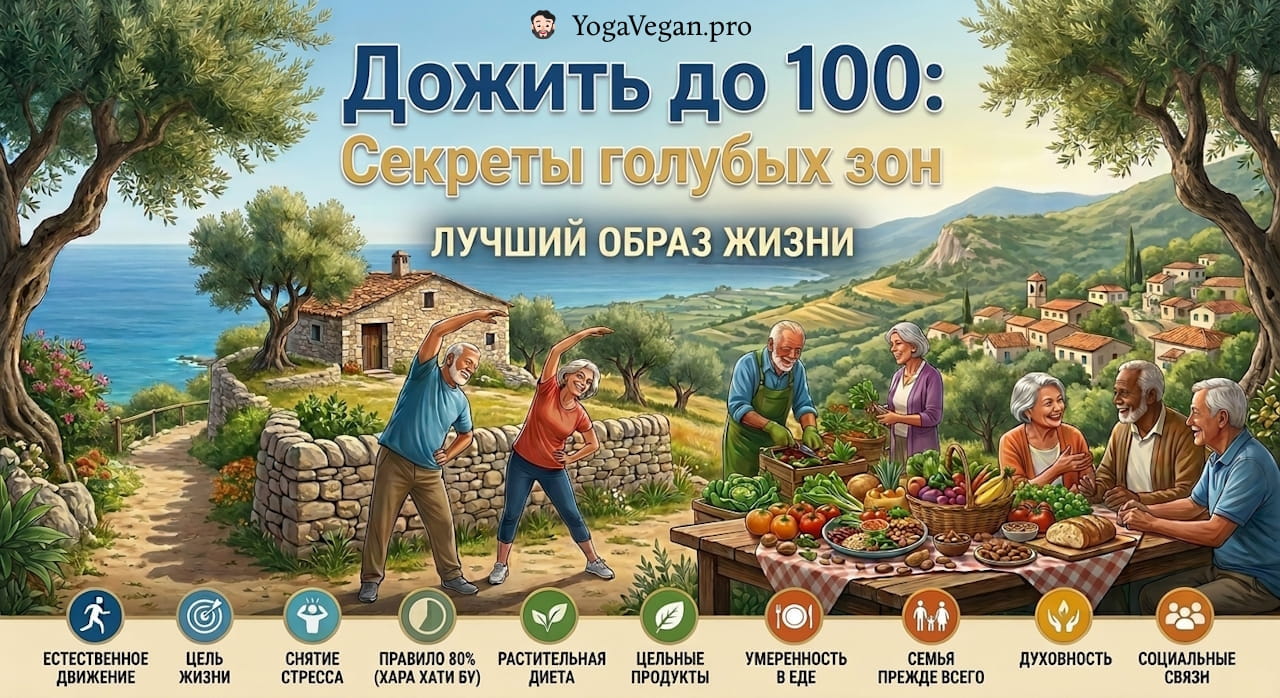
🎬 Live to 100: Secrets of the Blue Zones
I recently watched "Live to 100: Secrets of the Blue Zones" and got the impression that it is a filmed continuation of the amazing book: 📚 "Nutrition and Physical Degeneration" - Weston Price. Like the book, the series captivates from the first minute: beautiful imagery, interesting meanings, and the search for truth.
Researcher Dan Buettner travels the world and looks for centenarians and tries to figure out how and at the expense of what they live so long and get sick less often with chronic diseases? The main idea from the author: longevity is not the result of diets or intensive training but a natural consequence of a special lifestyle formed by the environment.
In four episodes Buettner visits the so-called "blue zones" — regions with the highest concentration of centenarians. These include:
- Okinawa (Japan): Here live the oldest women in the world, and their life is filled with a sense of purpose "ikigai."
- Sardinia (Italy): The homeland of the oldest men, who work on farms and walk in the mountains until old age.
- Ikaria (Greece): An island where people adhere to the Mediterranean diet and traditions that promote longevity.
- Nicoya (Costa Rica): A peninsula whose inhabitants are active until old age thanks to special diets and a sense of purpose.
- Loma Linda (USA): A Seventh-day Adventist community that adheres to vegetarianism and leads a close-knit lifestyle.
The series not only shows exotic places but also answers the question of whether such zones can be created in the modern world (for example, in Singapore).
🥗 The best nutrition
Nutrition in the "blue zones" has much in common, although it differs in details. The main principle is the predominance of plant food (up to 95% of the diet).
- Basis of the diet: Legumes (beans, lentils), whole grains, vegetables, fruits, nuts, and seeds.
- Meat and fish: Meat is eaten rarely, mainly on holidays and in small portions. Fish (preferably small, like sardines, to avoid mercury accumulation) is present in the menu more often but not daily.
- Dairy products and eggs: Cow's milk is practically excluded. Eggs are eaten no more than 2–4 times a week, usually as an addition to a dish, not as the main one.
- Drinks: Preference is given to water. Alcohol, if consumed, is in moderation, mainly red wine.
- Sugar: Consumption of added sugar is minimized, about five times less than the average for US residents.
- Flour: Their own whole coarse grind.
- The "Hara Hachi Bu" principle: Okinawa residents practice the rule "eat until you are 80% full" to avoid overeating.
🚶 The best lifestyle
Longevity in the "blue zones" is not only food but also a certain way of life. Researchers identify 9 common traits:
- Natural movement: Physical activity is built into everyday life (gardening, walking, household chores), not a separate workout.
- Purpose in life: Having "ikigai" — a reason to get up in the morning — gives motivation and prolongs life.
- Stress relief: Daily rituals for relaxation, whether meditation, prayer, or an afternoon nap.
- The 80% rule: The already mentioned "Hara Hachi Bu" principle.
- Plant-based diet: Predominance of whole plant nutrition in the diet.
- Moderation in alcohol: Abstinence or consumption of 1–3 glasses of red wine per day.
- Spirituality/Religion: Belonging to a spiritual community.
- Family first: Strong family ties and care for elders.
- Social connections: Having a circle of friends who support healthy habits (for example, "moai" in Okinawa).
📝 Conclusion
The book 📚 "Nutrition and Physical Degeneration" - Weston Price and the current series are connected by one idea that the author of the series mentions in passing — in basically all the blue zones where centenarians live, civilization came not so long ago. In the book Weston says directly that people live longer and get sick less where there is no modern civilization, where there is no modern bleached flour, no concentrated refined sugar and canned goods. Where people live in their primitive society — they get their own food. However, Dan Buettner noticed what Weston did not pay attention to — that people's health is significantly higher where there is more whole plant nutrition, less meat, and more natural physical activity.
An example of an isolated people on traditional whole plant nutrition: 🎬 The Hunza live up to 160 years, average 120, give birth at 65. What is the secret?